
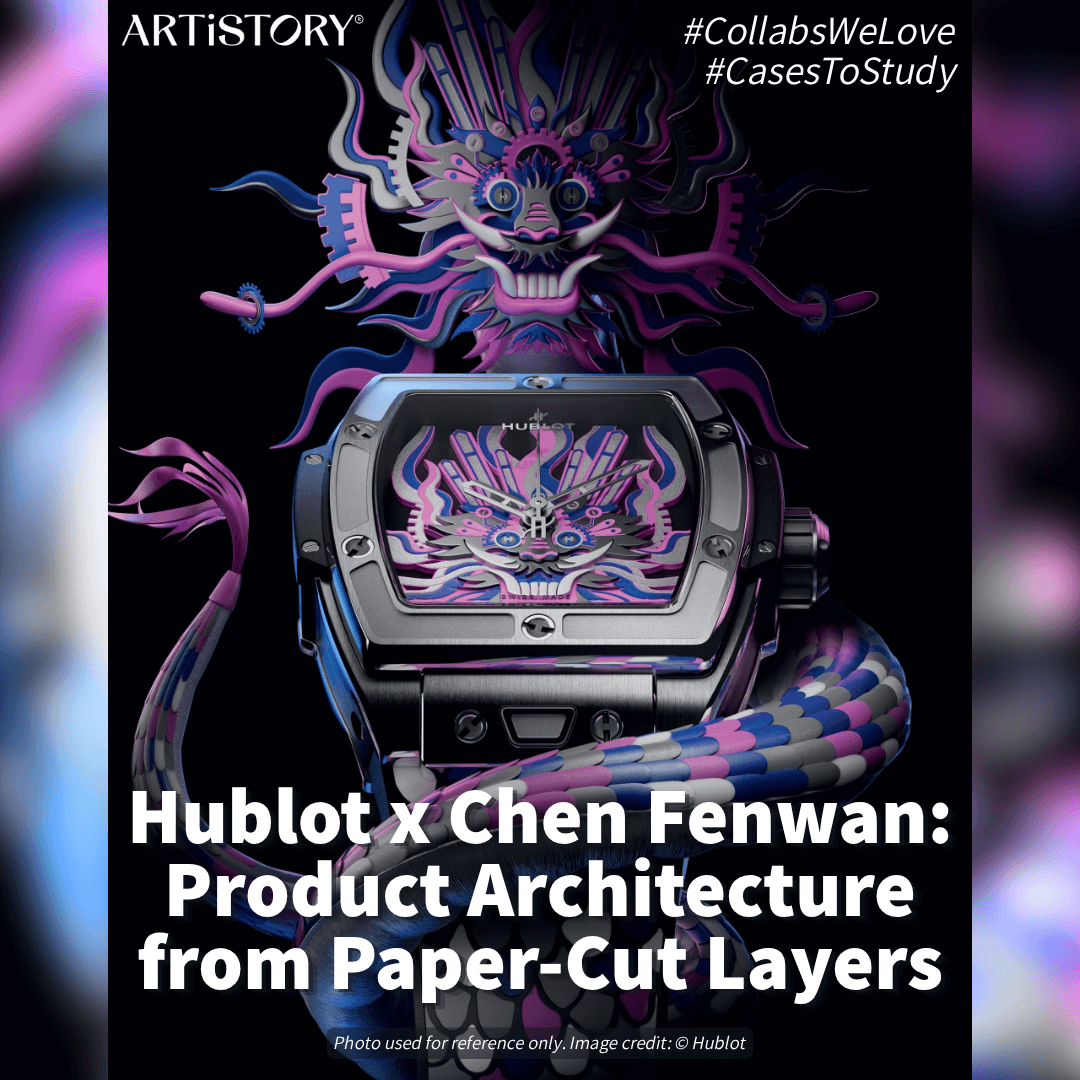
From paper-cut layers to titanium marquetry, Hublot’s Spirit of Big Bang Titanium Dragon transforms Chen Fenwan’s dragon language into product architecture. The watch does not simply borrow a motif; it rebuilds the depth, movement, and silhouette of Chinese paper cutting inside the dial.
Photo used for reference only. Image credit: © Hublot.
Hublot x Chen Fenwan: Chinese Paper-Cutting as Product Arch
Key Takeaway
The Hublot x Chen Fenwan Spirit of Big Bang Titanium Dragon shows how Chinese paper-cutting can move beyond decorative motif into product architecture. By translating jianzhi's layers, negative space, dragon silhouette, and marquetry logic into a limited-edition titanium watch, the collaboration becomes a benchmark for cultural IP partnerships that respect both craft intelligence and luxury storytelling.
About the Author
ARTiSTORY offers a demand-driven portfolio of art and cultural IP, empowering brands, retailers, and venues to create authentic, culture-rich products and experiences. With access to over 170 million artifacts and artworks, as well as 30+ UNESCO-recognized intangible cultural heritages, we help our partners attract consumers drawn to art, culture, and meaning. Please refer to Our Works to see what ARTiSTORY worked with Dunhuang Mogao Cave and fashion brand Levi's.
News
ARTiSTORY Staff
• 3 minute read
Hublot x Chen Fenwan: When Chinese Paper-Cutting Becomes Product Architecture
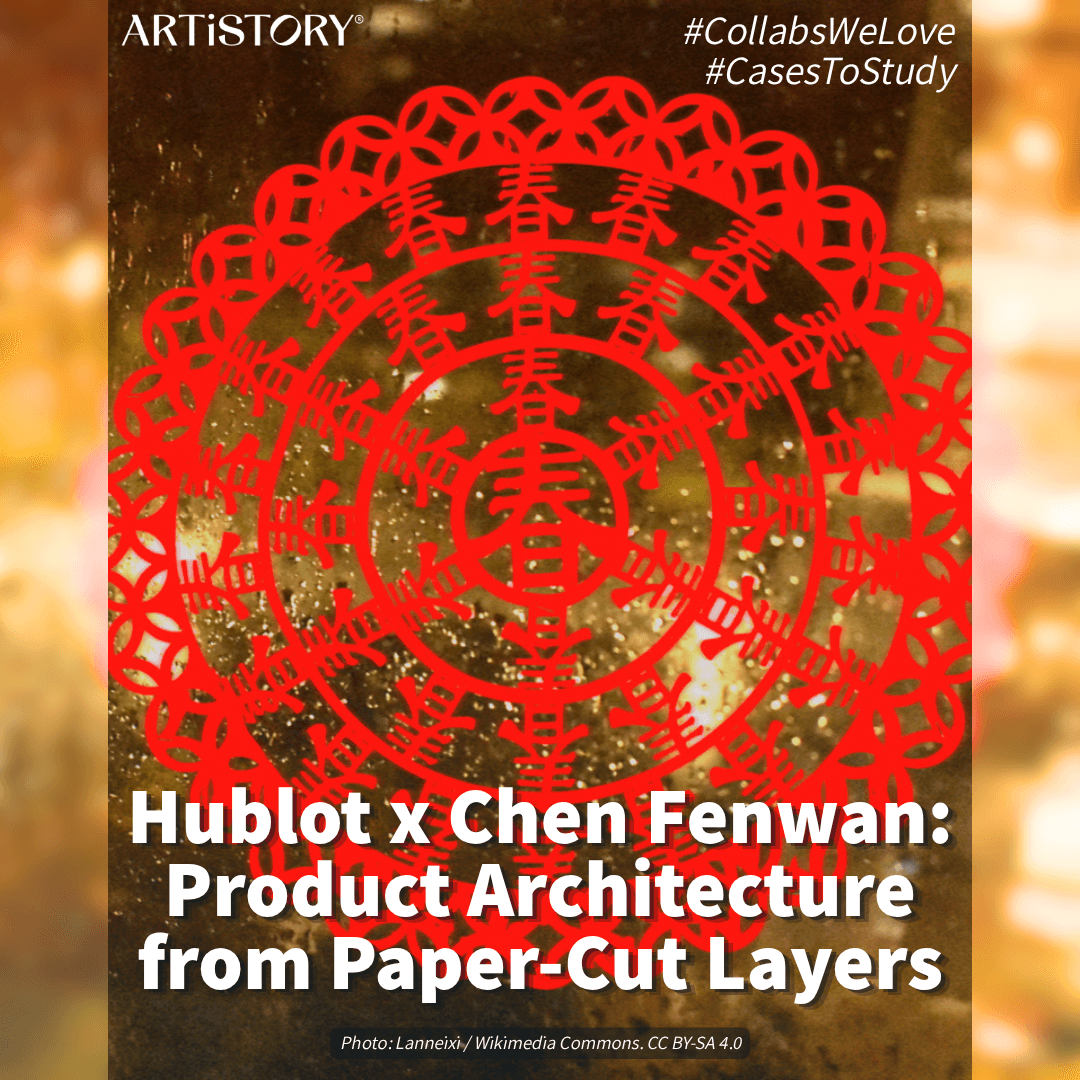
Chinese paper cutting - Spring Character (春). Photo: Lanneixi / Wikimedia Commons. CC BY-SA 4.0.
Chinese paper-cutting, or jianzhi (剪纸), is often described through its most familiar visual language: red paper, symmetrical motifs, zodiac animals, flowers, and festival windows. Yet UNESCO's inscription of Chinese paper-cutting recognizes a living craft practice, not simply an image style. Its real value lies in how it thinks: through removal, negative space, folding, rhythm, and the control of a single plane.
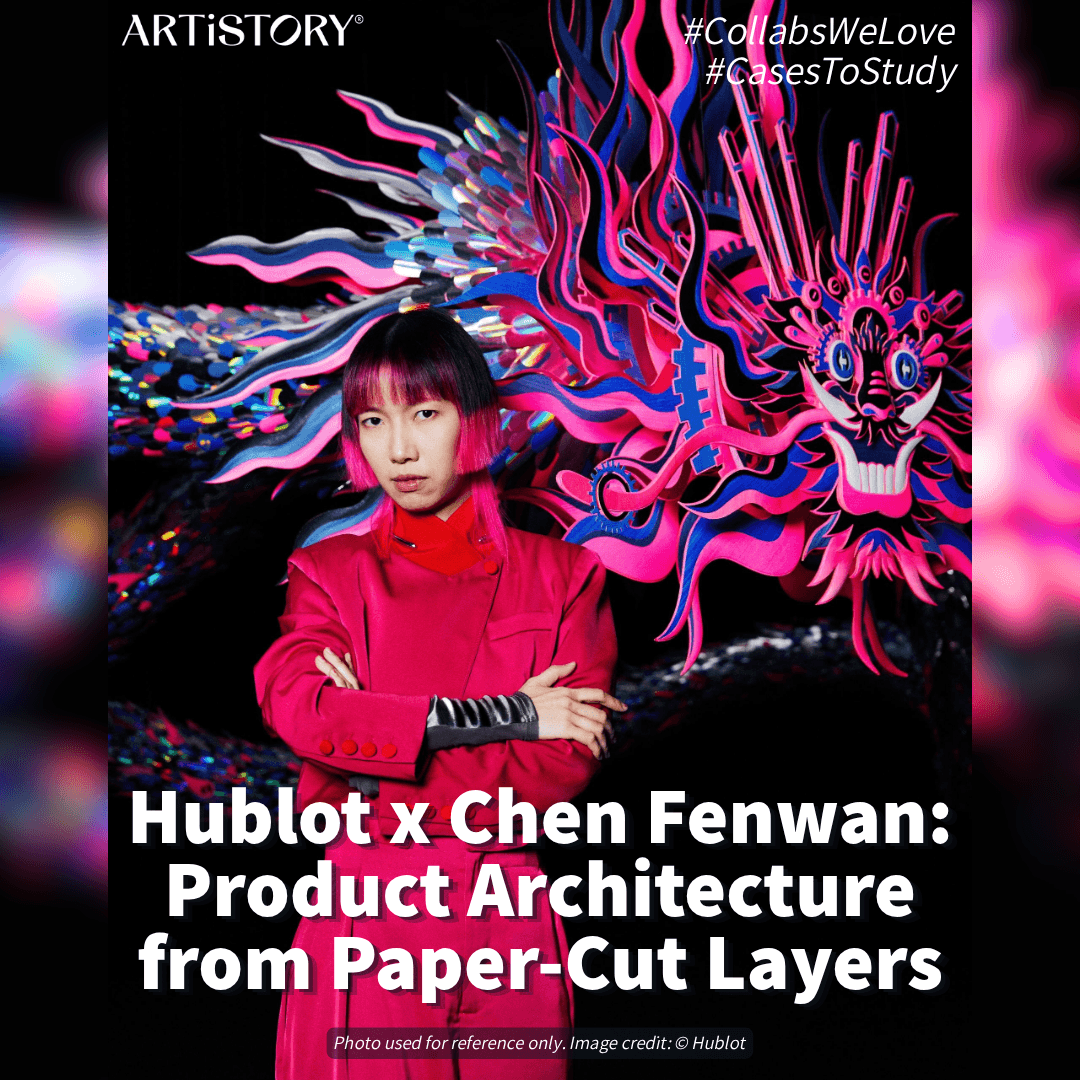
Chen Fenwan’s paper-cut practice gives the dragon form through repetition, layering, and negative space. In Hublot’s limited-edition watch, that same visual logic becomes a luxury object: layered components, dimensional depth, and a dragon silhouette built from structure rather than surface.
Photo used for reference only. Image credit: © Hublot.
That is why the Hublot Spirit of Big Bang Titanium Dragon created with Chen Fenwan is a useful case study for luxury brands. The watch does not only reference Chinese paper-cutting. It translates the craft's logic into a physical product: a 42mm titanium object where depth, layers, and marquetry create the dragon.
From motif to construction logic
Many heritage collaborations begin with a motif. A brand selects a symbol, applies it to a product surface, and builds a campaign around recognition. The Hublot x Chen Fenwan case is more sophisticated because the dragon is treated as a structural system. The design language is not simply dragon imagery; it is the way a dragon emerges through stacked shapes, alternating colors, shadow, and void.
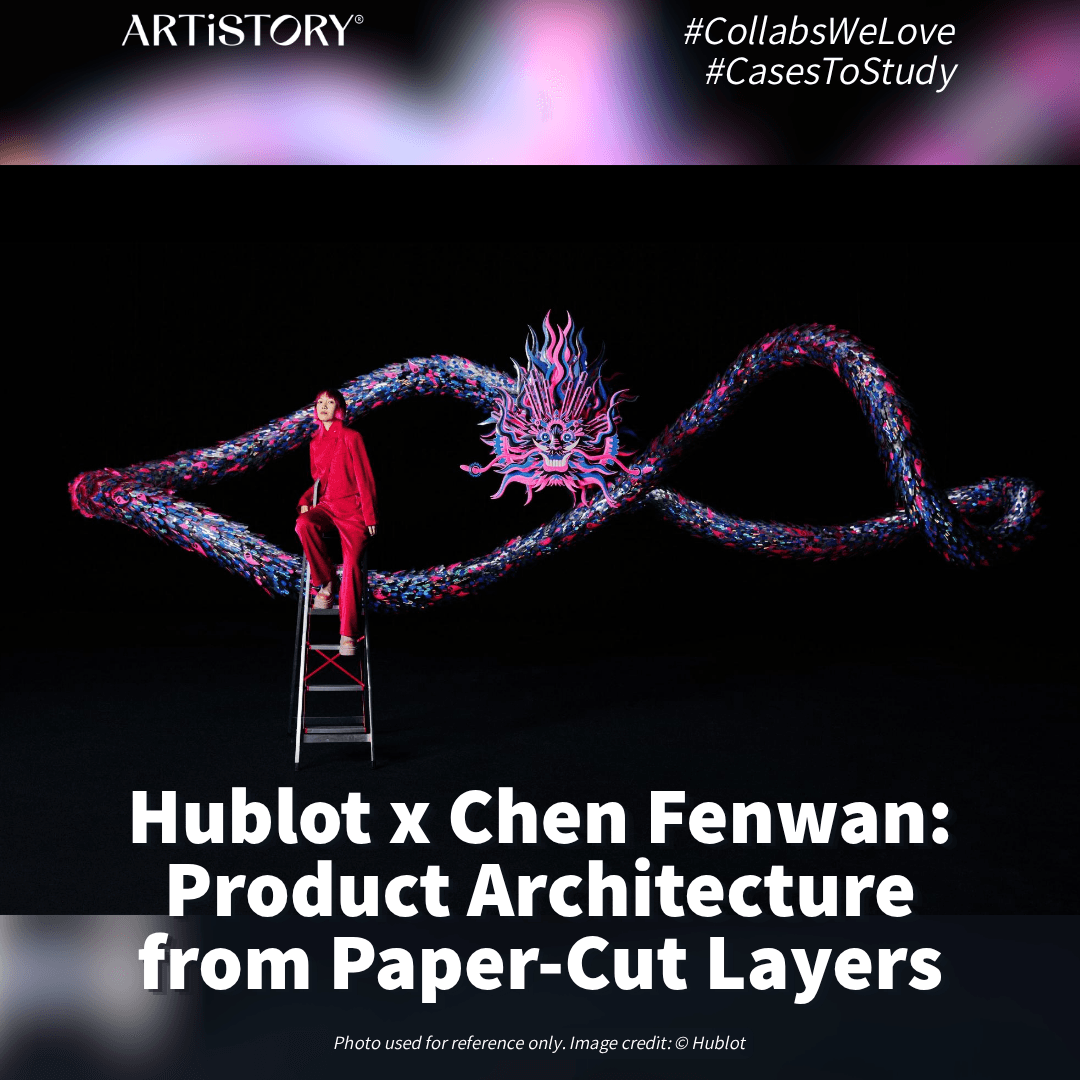
At full scale, Chen Fenwan’s dragon is almost architectural: a body built from layered fragments, color, rhythm, and movement. Hublot’s collaboration draws from this language of construction, translating the craft of Chinese paper cutting into the precision world of high watchmaking.
Photo used for reference only. Image credit: © Hublot.
Watch coverage from GQ describes the limited edition as 88 pieces and notes the dragon dial, artist collaboration, and dragon-scale rubber marquetry strap. Those details matter because they show the product translating multiple features of paper-cutting at once: the dial as layered image, the strap as scale rhythm, and the collector edition as cultural storytelling.
Chen Fenwan and the architectural reading of paper
Chen Fenwan's work is valuable to this story because it already pushes paper-cutting beyond a flat surface. Her large-scale dragon works use suspended layers and repeated cut forms to make paper behave like architecture. The viewer reads the dragon through depth and movement, not through a single flat image.
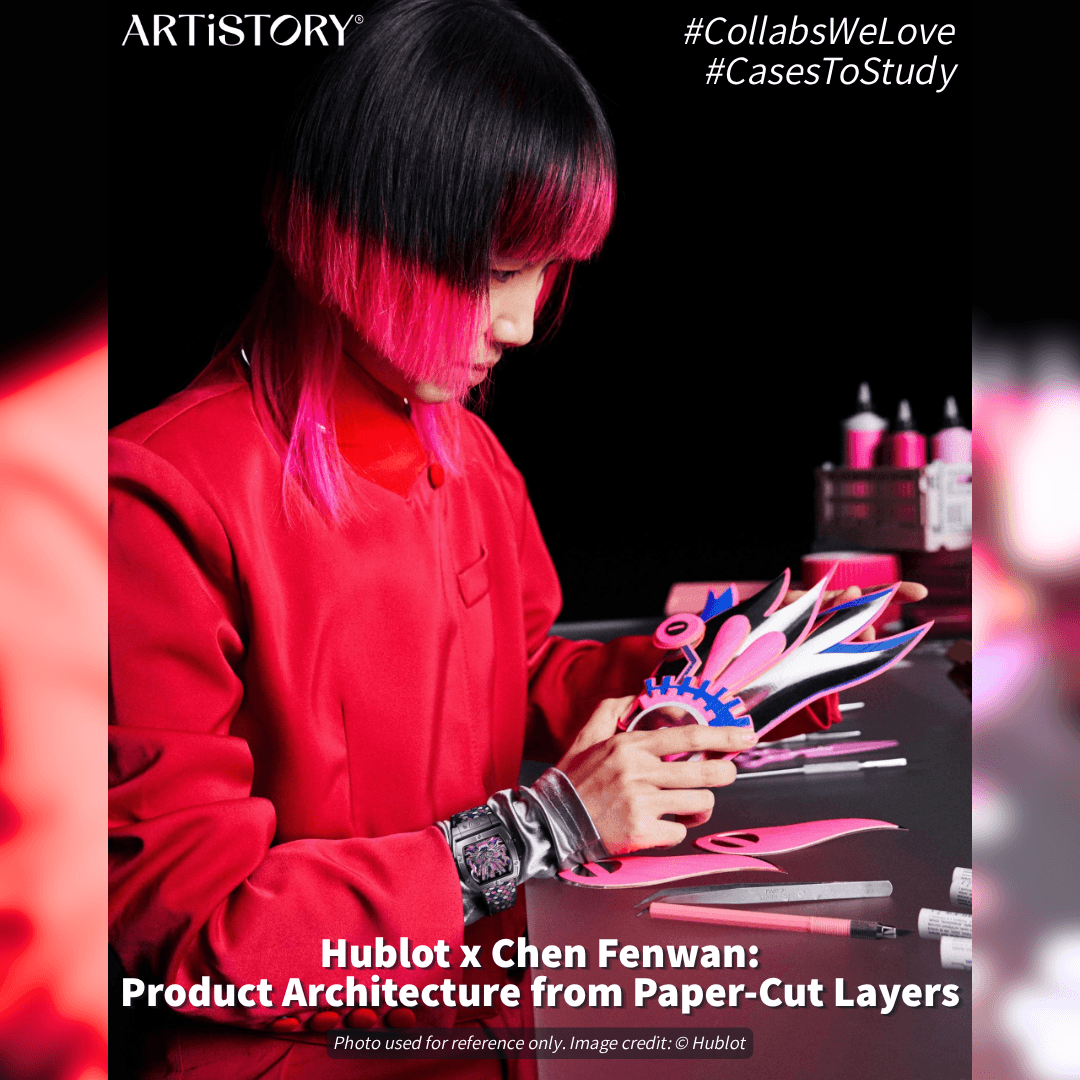
The strength of this collaboration begins at the worktable. Chen Fenwan’s cut-paper forms reveal how heritage craft can guide product design at a structural level: layer by layer, plane by plane, until the dragon becomes both artwork and object.
Photo used for reference only. Image credit: © Hublot.
For brands exploring cultural IP, this is the difference between decoration and translation. ARTiSTORY's cultural IP portfolio is built around that distinction: cultural assets are most powerful when their material intelligence, maker knowledge, and narrative context are carried into new products with care.
Why layers matter in luxury storytelling
Luxury depends on visible and invisible labor: material selection, handwork, limited production, and the feeling that an object contains more than immediate function. Chinese paper-cutting offers an unusually strong vocabulary for this. A cut line is both image and evidence of the hand. A void is not empty; it is how the form appears. A layer is not just thickness; it is time, sequence, and craft intelligence.
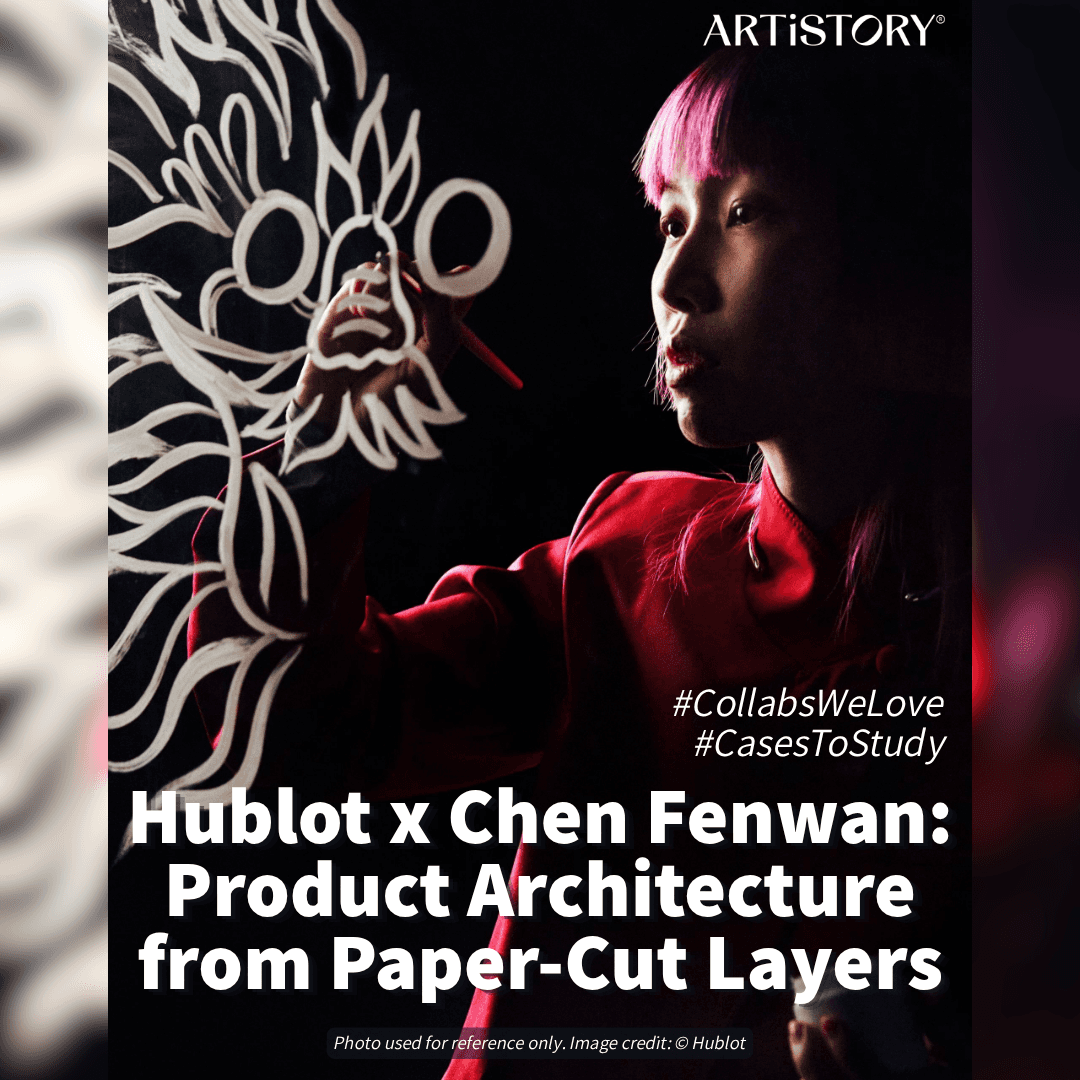
Chinese paper cutting is a discipline of precision: every cut defines both line and void. Chen Fenwan brings that discipline into a contemporary visual language, where the dragon is not drawn on the surface but assembled through depth, shadow, and layered form.
Photo used for reference only. Image credit: © Hublot.
In the Hublot watch, that vocabulary becomes horology. The dragon is not a flat graphic under glass. It appears through assembled planes, tonal contrast, and a strap treatment that echoes scales. This is why the case study is relevant beyond watches: it suggests how paper-cutting could guide jewelry relief, leather goods embossing, packaging windows, retail installations, fragrance caps, stationery, and experiential environments.
Commercial Angle: What brands can learn
The commercial lesson is clear: source-led cultural collaboration can create premium value when it becomes product architecture. Through merchandise licensing, brands can translate craft principles into collectible objects, limited editions, gifting programs, and design systems. Through promotion licensing, the same craft logic can extend into launch windows, boutique activations, seasonal campaigns, and market-specific storytelling.
For projects that require artist discovery, curatorial review, approvals, and cultural context, ARTiSTORY's collaboration consulting helps brands move from inspiration to responsible execution. The Hublot x Chen Fenwan case demonstrates why that process matters: the strongest result is not a symbol placed on a product, but a product that carries the structure of the source tradition.
FAQ
What is the Hublot x Chen Fenwan Spirit of Big Bang Titanium Dragon?
It is a 2024 limited-edition Hublot watch connected to Chinese paper-cutting and Chen Fenwan's dragon language, using layered components and marquetry-like details to form a dragon design.
Why is this more than surface decoration?
Because the collaboration translates paper-cutting's construction logic - layers, negative space, silhouette, and rhythm - into the watch's dial and strap, rather than simply printing a motif on the surface.
How can other brands apply this lesson?
Brands can start with the craft's material intelligence, identify a living practitioner or verified cultural source, and build product categories where the tradition can shape structure, experience, and storytelling.


ARTiSTORY helps brands turn the right cultural source into validated concepts, production-ready design assets and market-ready storytelling.
" height="15.00095079498291px" id="KzAesqen_" width="15.887237074279785px"/></svg>)
" height="40px" id="PdXwlesgs" width="40px"/></svg>)
" height="16.6667px" id="bN179avM0" width="16.66250000000001px"/></svg>)
" height="40px" id="sK1n39Y12" width="40px"/></svg>)
" height="13.333300000000001px" id="e3sm3FX65" width="16.662000000000006px"/></svg>)
" height="40px" id="BlhXMiVl0" width="40px"/></svg>)
" height="16.666358956956856px" id="WrXlTUAw7" width="16.668330260537772px"/></svg>)
" height="40px" id="nKu2x0iOq" width="40px"/></svg>)
Services
© 2026 ARTiSTORY. All rights reserved.
Privacy Policy
Terms of Service
Cookie Policy