
Back to Stories
The Nursery Alice: Lewis Carroll’s Gift to Young Readers
Key Takeaway
The Nursery "Alice" (1890) is Lewis Carroll’s interactive retelling for toddlers, featuring the first authorized colour illustrations by Sir John Tenniel. Notably, it depicts Alice in a yellow dress—a distinct visual asset that sets it apart from the standard blue, offering a unique, authentic aesthetic for vintage-inspired commercial licensing in the baby and nursery market.
About ARTiSTORY
ARTiSTORY offers a demand-driven portfolio of art and cultural IP, empowering brands, retailers, and venues to create authentic, culture-rich products and experiences. With access to over 170 million artifacts and artworks, as well as 30+ UNESCO-recognized intangible cultural heritages, we help our partners attract consumers drawn to art, culture, and meaning. Please refer to Our Works to see what ARTiSTORY worked with Dunhuang Mogao Cave and fashion brand Levi's.
Literary Classics
ARTiSTORY Staff
• 3 minute read
Decades after Alice’s Adventures in Wonderland captivated the world, Lewis Carroll revisited his masterpiece with a specific audience in mind: children "from Nought to Five." Published in 1890, The Nursery "Alice" is not merely an abridged version of the 1865 classic but a complete reimagining. Carroll rewrote the narrative with a conversational, interactive tone, directly addressing the young listener with questions like, "Which would you have liked the best, do you think, to be a little tiny Alice... or a great tall Alice?" This shift from story telling to story sharing reveals Carroll’s deep affection for his youngest fans, transforming the text into an engaging, spoken-word experience.
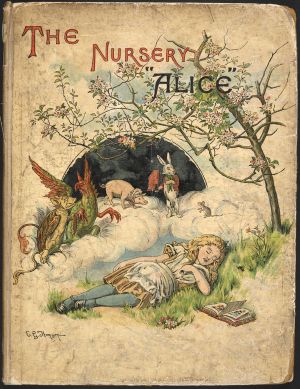
The Nursery “Alice”
Cup.410.g.74 Front cover
Author:Lewis Carroll
Illustration:Sir John Tenniel
1890
Image: From the British Library collection
Visually, The Nursery "Alice" is significant for being the first colour edition of the Alice books. Sir John Tenniel, the original illustrator, returned to adapt twenty of his iconic wood engravings. These weren't simply filled in; they were enlarged, refined, and coloured under his direct supervision. A striking detail in this edition is Alice's appearance: unlike the now-ubiquitous blue dress popularized by later adaptations (most notably Disney), Tenniel’s Nursery Alice wears a vibrant yellow dress with a blue ribbon. This specific colour choice remains a key differentiator for purists and collectors, marking the "true" original colour vision of the creators.
The cover art also marked a departure, featuring work by E. Gertrude Thomson rather than Tenniel, offering a softer, more sentimental aesthetic that bridged the gap between the sharpness of Tenniel’s engravings and the gentle tone of the nursery adaptation. This collaboration highlights the book’s unique position as a hybrid artifact—part literary classic, part Victorian nursery object.
The Commercial Angle
While Alice is a saturated market, The Nursery "Alice" offers a niche "heritage" opportunity. The unique yellow-dress Alice and E. Gertrude Thomson’s softer cover art are virtually untapped assets. These could anchor a "Vintage Nursery" collection for high-end baby brands, featuring pastel-toned bedding, soft toys, and "first year" keepsake journals that prioritize the authentic, gentle Victorian aesthetic over modern cartoon interpretations.
ARTiSTORY offers a demand‑driven portfolio of art and cultural IP, empowering brands, retailers, and venues to create authentic, culture‑rich products and experiences. With access to over 170 million artifacts and artworks, as well as 30+ UNESCO‑recognized intangible cultural heritages, we help our partners attract consumers drawn to art, culture, and meaning. Please refer to Our Works to see what ARTiSTORY worked with Dunhuang Mogao Cave and fashion brand Levi’s.
Back to Home

Connecting cultures through meaningful brand collaborations and authentic storytelling that drives both impact and revenue.
" height="15.00095079498291px" id="KzAesqen_" width="15.887237074279785px"/></svg>)
" height="40px" id="PdXwlesgs" width="40px"/></svg>)
" height="16.6667px" id="bN179avM0" width="16.66250000000001px"/></svg>)
" height="40px" id="sK1n39Y12" width="40px"/></svg>)
" height="13.333300000000001px" id="e3sm3FX65" width="16.662000000000006px"/></svg>)
" height="40px" id="BlhXMiVl0" width="40px"/></svg>)
" height="16.666358956956856px" id="WrXlTUAw7" width="16.668330260537772px"/></svg>)
" height="40px" id="nKu2x0iOq" width="40px"/></svg>)
Services
© 2026 ARTiSTORY. All rights reserved.
Privacy Policy
Terms of Service
Cookie Policy