
Back to Stories
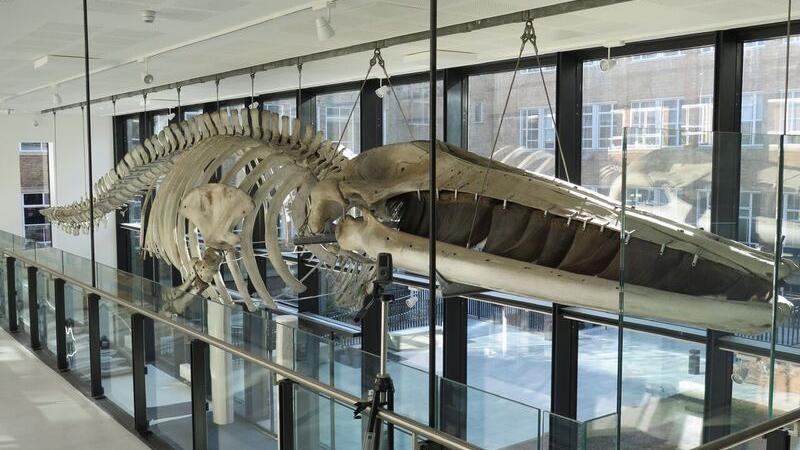
The Fin Whale at Cambridge University: A Victorian Giant
Key Takeaway
Washed ashore in 1865 and displayed for sixpence before reaching Cambridge, this 21-meter Fin Whale skeleton is a Victorian relic turned conservation icon. Dominating the modern "Whale Hall," it offers immense educational value and commercial potential for "Oceanic Heritage" product lines, ranging from anatomical art prints to sustainable, eco-conscious stationery.
About ARTiSTORY
ARTiSTORY offers a demand-driven portfolio of art and cultural IP, empowering brands, retailers, and venues to create authentic, culture-rich products and experiences. With access to over 170 million artifacts and artworks, as well as 30+ UNESCO-recognized intangible cultural heritages, we help our partners attract consumers drawn to art, culture, and meaning. Please refer to Our Works to see what ARTiSTORY worked with Dunhuang Mogao Cave and fashion brand Levi's.
Museum Collection
ARTiSTORY Staff
• 3 minute read
In November 1865, the quiet shores of Pevensey Bay in Sussex were disrupted by the arrival of a leviathan. A massive Fin Whale, one of the ocean's most elusive giants, had washed ashore, drawing crowds of Victorian spectators who had likely never seen a creature of such magnitude. This tragic event marked the beginning of a remarkable journey for the animal, transforming it from a biological curiosity on a pebble beach into the crown jewel of the University of Cambridge’s Museum of Zoology.
Before arriving in the hallowed halls of academia, the whale’s skeleton served a stint as a paid attraction. In a move typical of the era's showmanship, the bones were first displayed at the Central Cricket Ground in Hastings, where curious visitors paid sixpence to marvel at the remains of the deep. It wasn't until 1866 that the museum acquired the specimen, securing its legacy as an object of scientific study rather than mere spectacle.
Today, this 21-meter (70-foot) skeleton dominates the museum's entrance, suspended in the light-filled "Whale Hall." Known scientifically as Balaenoptera physalus, the Fin Whale is the second-largest animal to have ever lived, surpassed only by the Blue Whale. To put its scale into perspective, the living animal would have weighed approximately 80 tonnes—roughly the equivalent of eight double-decker buses. Its presence in the museum is commanding; the sheer length of the ribcage and the sweeping curve of the spine dwarf the visitors walking beneath it, offering a visceral reminder of the scale of life in our oceans.
The skeleton is not just a monument to size; it is a biological textbook written in bone. The Fin Whale is a mysticete, or baleen whale, equipped with fringed plates instead of teeth to filter krill and small fish from the water. While the soft tissues—such as the species' unique asymmetrical colouring, with a white right jaw and dark left jaw—are gone, the bones tell the story of its evolutionary adaptation. The massive jaws once held hundreds of baleen plates, and the spinal structure hints at the powerful swimming capabilities that make this species the "greyhound of the sea."
The whale's recent history is as significant as its Victorian origins. During the museum's major redevelopment in the 2010s, the skeleton was dismantled and placed in storage for four years. Its triumphant return in 2017 required a complex engineering feat, taking a specialist team four weeks to rehang the bones in the new glass atrium. Now acting as the museum's figurehead, the Fin Whale bridges the gap between 19th-century natural history collecting and 21st-century conservation awareness, greeting a new generation of students and public visitors with the silent, majestic narrative of the natural world.
The Commercial Angle
The "Whale Hall" aesthetic offers a prime opportunity for an "Oceanic Heritage" collection. The skeleton’s architectural elegance could be translated into high-end, blueprint-style art prints or bone-china tableware featuring anatomical motifs. Additionally, a line of sustainable stationery made from recycled ocean plastics would align perfectly with the museum’s conservation mission.
ARTiSTORY offers a demand‑driven portfolio of art and cultural IP, empowering brands, retailers, and venues to create authentic, culture‑rich products and experiences. With access to over 170 million artifacts and artworks, as well as 30+ UNESCO‑recognized intangible cultural heritages, we help our partners attract consumers drawn to art, culture, and meaning. Please refer to Our Works to see what ARTiSTORY worked with Dunhuang Mogao Cave and fashion brand Levi’s.
Back to Home

Connecting cultures through meaningful brand collaborations and authentic storytelling that drives both impact and revenue.
" height="15.00095079498291px" id="KzAesqen_" width="15.887237074279785px"/></svg>)
" height="40px" id="PdXwlesgs" width="40px"/></svg>)
" height="16.6667px" id="bN179avM0" width="16.66250000000001px"/></svg>)
" height="40px" id="sK1n39Y12" width="40px"/></svg>)
" height="13.333300000000001px" id="e3sm3FX65" width="16.662000000000006px"/></svg>)
" height="40px" id="BlhXMiVl0" width="40px"/></svg>)
" height="16.666358956956856px" id="WrXlTUAw7" width="16.668330260537772px"/></svg>)
" height="40px" id="nKu2x0iOq" width="40px"/></svg>)
Services
© 2026 ARTiSTORY. All rights reserved.
Privacy Policy
Terms of Service
Cookie Policy