
Back to Stories
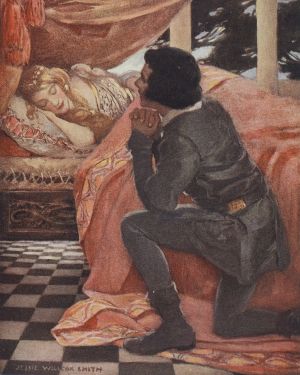
Sleeping Beauty: Jessie Willcox Smith Art | ARTiSTORY
Key Takeaway
Jessie Willcox Smith’s 1911 illustrations for Sleeping Beauty redefine the classic fairy tale with a focus on domestic warmth and childhood innocence. Distinct from high-fantasy interpretations, her soft, pastel-hued style offers a "heritage" aesthetic that is ideal for luxury nursery products, appealing to consumers seeking timeless, nostalgic elegance.
About ARTiSTORY
ARTiSTORY offers a demand-driven portfolio of art and cultural IP, empowering brands, retailers, and venues to create authentic, culture-rich products and experiences. With access to over 170 million artifacts and artworks, as well as 30+ UNESCO-recognized intangible cultural heritages, we help our partners attract consumers drawn to art, culture, and meaning. Please refer to Our Works to see what ARTiSTORY worked with Dunhuang Mogao Cave and fashion brand Levi's.
Literary Classics
ARTiSTORY Staff
• 3 minute read
The tale of Sleeping Beauty is one of the most enduring narratives in Western folklore, with roots stretching back to the 14th-century romance Perceforest and Giambattista Basile’s Sun, Moon, and Talia (1634). However, it was Charles Perrault who refined the story in 1697, adding the christening, the seven fairies, and the hundred-year sleep. The Brothers Grimm later sanitized the darker elements (such as the cannibalistic mother-in-law found in Perrault’s version) to create the romantic "Briar Rose" tale we know today.
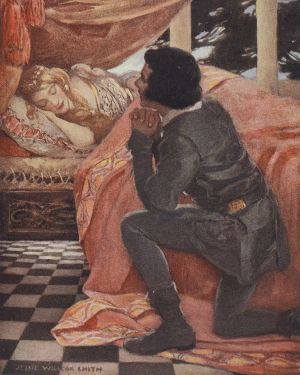
Sleeping Beauty
12804.y.6112804.y.6112804.y.6112804.y.61
Jessie Willcox Smith
19131913
Image: From the British Library collection
In the early 20th century, American illustrator Jessie Willcox Smith brought her unique vision to this classic. A student of the famous Howard Pyle, Smith was a central figure in the "Golden Age of American Illustration." Her interpretation of Sleeping Beauty—created for A Child’s Book of Stories (1911)—is distinct for its tenderness and focus on the child. Unlike the dramatic, high-fantasy style of Arthur Rackham, Smith’s work is grounded in domestic warmth. Her Sleeping Beauty is often depicted not as a distant royal figure, but with the soft, flushed cheeks and natural posture of a real child, reflecting Smith’s signature ability to capture the innocence and sanctity of childhood.
Smith’s illustrations for the story use a soft, warm color palette, often favoring pastels and diffused light that give the scenes a dreamlike, nursery-appropriate quality. The visual storytelling emphasizes safety and peace even within the curse, suggesting a gentle slumber rather than a death-like trance. This approach made the story accessible and comforting to her primary audience—young children and their mothers—and solidified her reputation as one of the "Red Rose Girls," a group of female illustrators who redefined the visual language of domestic life and childhood.
The Commercial Angle
Jessie Willcox Smith’s work is synonymous with nostalgic, high-end Americana. While Disney dominates the mass market, Smith’s Sleeping Beauty offers a sophisticated "heritage" alternative. The soft, painterly aesthetic is perfect for a luxury nursery collection—think organic cotton swaddles, heir-quality woolen blankets, and ceramic keepsake boxes that appeal to grandparents and gift-givers seeking traditional, timeless elegance over cartoonish branding.
ARTiSTORY offers a demand‑driven portfolio of art and cultural IP, empowering brands, retailers, and venues to create authentic, culture‑rich products and experiences. With access to over 170 million artifacts and artworks, as well as 30+ UNESCO‑recognized intangible cultural heritages, we help our partners attract consumers drawn to art, culture, and meaning. Please refer to Our Works to see what ARTiSTORY worked with Dunhuang Mogao Cave and fashion brand Levi’s.
Back to Home

Connecting cultures through meaningful brand collaborations and authentic storytelling that drives both impact and revenue.
" height="15.00095079498291px" id="KzAesqen_" width="15.887237074279785px"/></svg>)
" height="40px" id="PdXwlesgs" width="40px"/></svg>)
" height="16.6667px" id="bN179avM0" width="16.66250000000001px"/></svg>)
" height="40px" id="sK1n39Y12" width="40px"/></svg>)
" height="13.333300000000001px" id="e3sm3FX65" width="16.662000000000006px"/></svg>)
" height="40px" id="BlhXMiVl0" width="40px"/></svg>)
" height="16.666358956956856px" id="WrXlTUAw7" width="16.668330260537772px"/></svg>)
" height="40px" id="nKu2x0iOq" width="40px"/></svg>)
Services
© 2026 ARTiSTORY. All rights reserved.
Privacy Policy
Terms of Service
Cookie Policy