
Back to Stories
Silk Road Sanctuaries: Mogao’s Cave Worlds
Key Takeaway
The Mogao Caves at Dunhuang, a UNESCO World Heritage Site since 1987, preserve nearly a thousand years of Buddhist murals, sculptures, and manuscripts along the Silk Road. Through careful conservation and pioneering digital projects, this desert sanctuary remains both a fragile archaeological site and a globally accessible gallery of faith, art, and cultural exchange.
About ARTiSTORY
ARTiSTORY offers a demand-driven portfolio of art and cultural IP, empowering brands, retailers, and venues to create authentic, culture-rich products and experiences. With access to over 170 million artifacts and artworks, as well as 30+ UNESCO-recognized intangible cultural heritages, we help our partners attract consumers drawn to art, culture, and meaning. Please refer to Our Works to see what ARTiSTORY worked with Dunhuang Mogao Cave and fashion brand Levi's.
UNESCO Heritage Sites
ARTiSTORY Staff
• 3 minute read
In the desert outside Dunhuang, on the edge of the Gobi in China’s Gansu Province, a sheer cliff face is honeycombed with doorways. Behind each opening lies a painted world: Buddhas, bodhisattvas, donors, dancers, and distant landscapes glowing under the dim light of a shrine. These are the Mogao Caves, also known as the Caves of the Thousand Buddhas, one of the most extraordinary repositories of Buddhist art anywhere in the world. Carved into the cliffs above the Dachuan River, the complex preserves around 492 cave-temples with some 45,000 square metres of murals and more than 2,000 painted sculptures, spanning a thousand years of artistic activity from the 4th to the 14th century.
Mogao began, tradition says, when a monk named Lè Zūn had a vision of a thousand radiant Buddhas and ordered a cave cut into the cliff in 366 CE. Over the centuries that followed, other monks, craftspeople, and patrons continued to excavate and decorate chambers as places for meditation, worship, and merit-making. Dunhuang’s strategic position on the Silk Road meant that caravans, pilgrims, and envoys passed through regularly, bringing new ideas, styles, and religious texts from India, Central Asia, and later from the Chinese imperial heartland. This constant flow is written into the walls themselves, in pigments and plaster.
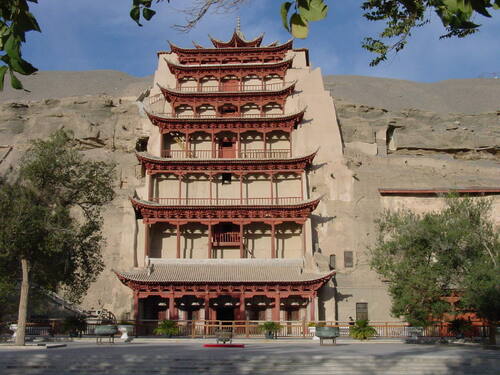
Mogao Caves: Nine‑storey wooden façade of Cave 96 at the Buddhist rock‑cut sanctuary near Dunhuang, Gansu Province, China.
site_0440_0002-500-0-20200821115337
Creator: Neville Agnew.
Place of production: Mogao Caves, Dunhuang oasis, Gansu Province, China.
Image: UNESCO World Heritage Convention collection for property no. 440
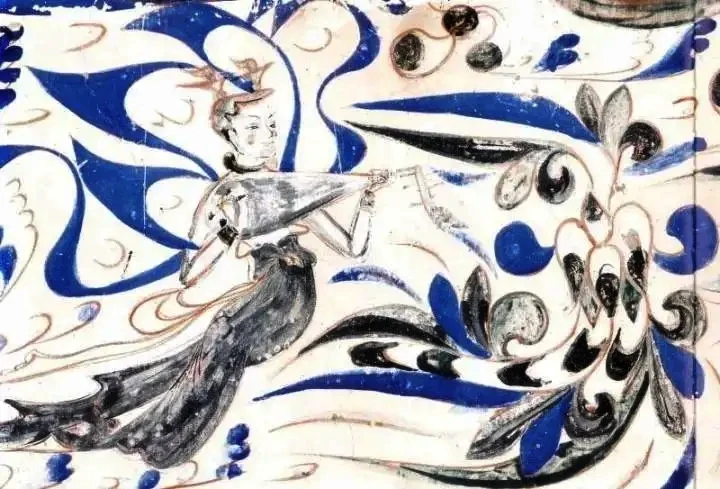
Art historians point out that the earliest caves at Mogao show clear Indian and Western Central Asian influences: slender Buddhas, rhythmic drapery, and compositions that echo earlier Gandharan models. During the Tang dynasty, when China was wealthy and cosmopolitan, the murals grow more elaborate and refined, reflecting the latest court painting styles—lush landscapes, detailed architecture, and processions of musicians and dancers swirling through celestial palaces. In later centuries, when Dunhuang became more isolated and a local painting academy took root, artists developed a distinct regional style, repeating popular motifs in mass-produced but still expressive compositions.
The caves are not only visual marvels; they are also a vast library of texts and objects. In 1900, a sealed side chamber now known as Cave 17, or the Library Cave, was discovered to contain tens of thousands of manuscripts, paintings on silk and paper, and other artefacts. These documents, later studied around the world, illuminated everyday religious practice, official life, and cross-cultural connections along the eastern Silk Roads. Together, the murals, sculptures, and manuscripts make Mogao an unparalleled source for understanding Buddhism’s spread into China and the wider network of ideas that flowed across Eurasia.
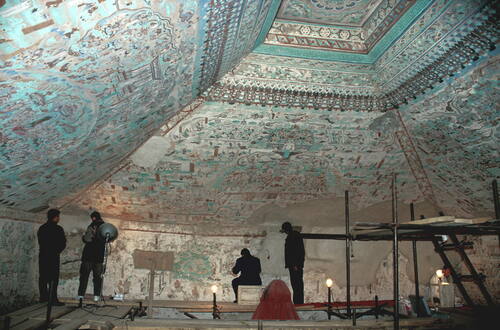
Mogao Caves: Conservation team working inside a decorated cave chamber with richly painted ceilings and walls at the Buddhist rock‑cut sanctuary near Dunhuang, Gansu Province, China.
site_0440_0003-500-0-20121214174851
Creator: Neville Agnew.
Place of production: Mogao Caves, Dunhuang oasis, Gansu Province, China.
Image: UNESCO World Heritage Convention collection for property no. 440
Recognising this unique concentration of art and history, UNESCO inscribed the Mogao Caves on the World Heritage List in 1987. The inscription notes that Mogao represents the largest, richest, and longest-used treasure house of Buddhist art known today and highlights its outstanding universal value as a record of political, economic, and cultural life in western China over more than a millennium. With this honour came an urgent responsibility: the caves are carved into a fragile cliff of soft rock, their pigments sensitive to changes in humidity, temperature, and light. Any damage, conservation experts warn, would be irreparable.
In response, China placed Mogao under top-level national protection and established the Dunhuang Academy as the main body responsible for its research, conservation, and visitor management. Since the late 1980s, the Academy has worked with international partners such as the Getty Conservation Institute and UNESCO to stabilise cave structures, repair flaking plaster, and develop careful standards for preserving both the physical site and its surrounding cultural landscape. Strict controls now limit visitor numbers and regulate how long groups can stay inside particular caves.
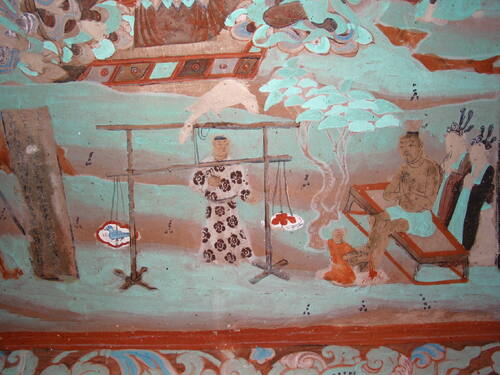
Mogao Caves: Detail of a painted mural scene inside a cave temple at the Buddhist rock‑cut sanctuary near Dunhuang, Gansu Province, China.
site_0440_0004-500-0-20121214175029
Creator: Francesca Piqué.
Place of production: Mogao Caves, Dunhuang oasis, Gansu Province, China.
Image: UNESCO World Heritage Convention collection for property no. 440
To balance access and preservation, Mogao has become a pioneer in digital heritage. High-resolution imaging projects, sometimes grouped under “Digital Dunhuang,” capture murals and sculptures in extraordinary detail, allowing scholars and the public to explore caves virtually even as physical access remains limited. Digital platforms hosted by the Dunhuang Academy and partner institutions present full cave reconstructions and manuscript collections online, turning a remote desert site into a resource that can be studied from classrooms and museums around the world. In this way, Mogao’s cave worlds continue to inspire new audiences while the original paintings rest in carefully controlled darkness.
Mogao, then, is more than a stop on an ancient trade route. It is a meeting point of faiths and empires, a workshop where artists translated complex Buddhist ideas into colour and line, and now a laboratory for 21st‑century conservation and storytelling. Standing before the cliff, with its lattice of entrances and the iconic pagoda façade of Cave 96, visitors glimpse only a fraction of the worlds within. Yet even that glimpse hints at the enduring power of images to carry belief, memory, and shared human curiosity across time and sand.
Commercial
The Mogao Caves’ mural motifs—floating bodhisattvas, patterned skies, and Silk Road caravans—lend themselves to limited-edition prints, immersive digital experiences, and capsule fashion or home collections co-developed with the Dunhuang Academy, where licensing directly supports conservation and public education.
ARTiSTORY offers a demand‑driven portfolio of art and cultural IP, empowering brands, retailers, and venues to create authentic, culture‑rich products and experiences. With access to over 170 million artifacts and artworks, as well as 30+ UNESCO‑recognized intangible cultural heritages, we help our partners attract consumers drawn to art, culture, and meaning. Please refer to Our Works to see what ARTiSTORY worked with Dunhuang Mogao Cave and fashion brand Levi’s.
Back to Home

Connecting cultures through meaningful brand collaborations and authentic storytelling that drives both impact and revenue.
" height="15.00095079498291px" id="KzAesqen_" width="15.887237074279785px"/></svg>)
" height="40px" id="PdXwlesgs" width="40px"/></svg>)
" height="16.6667px" id="bN179avM0" width="16.66250000000001px"/></svg>)
" height="40px" id="sK1n39Y12" width="40px"/></svg>)
" height="13.333300000000001px" id="e3sm3FX65" width="16.662000000000006px"/></svg>)
" height="40px" id="BlhXMiVl0" width="40px"/></svg>)
" height="16.666358956956856px" id="WrXlTUAw7" width="16.668330260537772px"/></svg>)
" height="40px" id="nKu2x0iOq" width="40px"/></svg>)
Services
© 2026 ARTiSTORY. All rights reserved.
Privacy Policy
Terms of Service
Cookie Policy