
Back to Stories

Title: Postage stamp of Ukraine (Petrykivka painting / Петриківський розпис)
Date: 2013
Culture: Ukrainian
Publisher / Author: Ukrposhta (Укрпошта)
Petrykivka: Living Ukrainian Art and Cultural Memory
Key Takeaway
Petrykivka is a traditional Ukrainian decorative painting style rooted in the rural settlement of Petrykivka in Dnipropetrovsk Oblast. It was inscribed on UNESCO's Representative List of the Intangible Cultural Heritage of Humanity in 2013, and remains meaningful because everyday surfaces become places where ornament, symbolism, craft practice, and cultural identity meet. For brands and licensees, its value is not simply visual; through ARTiSTORY's cultural IP portfolio, Petrykivka can be approached as a respectful story-first collaboration rooted in craft, maker context, and cultural significance, subject to appropriate rights and approvals.
About ARTiSTORY
ARTiSTORY offers a demand-driven portfolio of art and cultural IP, empowering brands, retailers, and venues to create authentic, culture-rich products and experiences. With access to over 170 million artifacts and artworks, as well as 30+ UNESCO-recognized intangible cultural heritages, we help our partners attract consumers drawn to art, culture, and meaning. Please refer to Our Works to see what ARTiSTORY worked with Dunhuang Mogao Cave and fashion brand Levi's.
UNESCO Intangible Cultural Heritage
ARTiSTORY Staff
• 3 minute read
Petrykivka: The Living Ukrainian Art of Flowers, Birds, and Cultural Memory
A village-born language of beauty
Petrykivka takes its name from the rural settlement of Petrykivka in east-central Ukraine. The tradition is closely associated with decorated house walls, domestic objects, and handmade compositions that brought ornament into ordinary life. Broader historical accounts often connect early examples and antecedents to the eighteenth century, while floral wall painting in the wider region is more strongly documented from the nineteenth and early twentieth centuries.
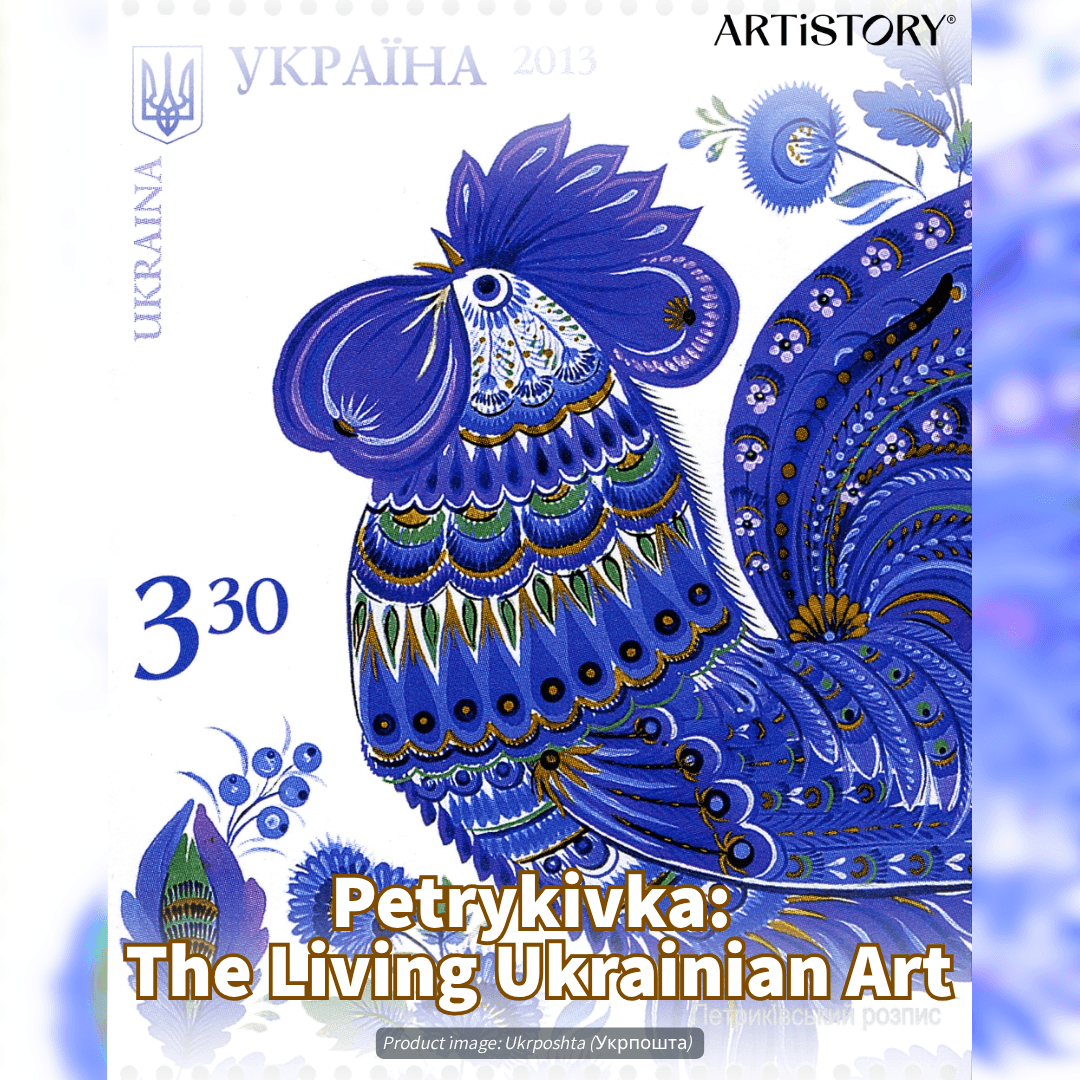
Title: Postage stamp of Ukraine (Petrykivka painting / Петриківський розпис)
Date: 2013
Culture: Ukrainian
Publisher / Author: Ukrposhta (Укрпошта)
What makes Petrykivka enduring is not only its beauty, but its closeness to everyday life. It was not conceived as distant museum art. It grew around homes, seasonal renewal, family rituals, household objects, and village identity. A flower on a wall, a bird on a chest, or a spray of berries on a useful object could be read as a gesture of welcome, good fortune, and continuity.
Why the motifs matter
Petrykivka is most often recognized by its abundant flowers, curling leaves, berries, birds, and sometimes fantastical creatures such as the firebird. Source-backed summaries describe the style as dominated by plant forms including garden flowers, wildflowers, viburnum berries, strawberries, grapes, and acanthus-like leaves; birds and animals often appear in profile, while flowers face the viewer directly.
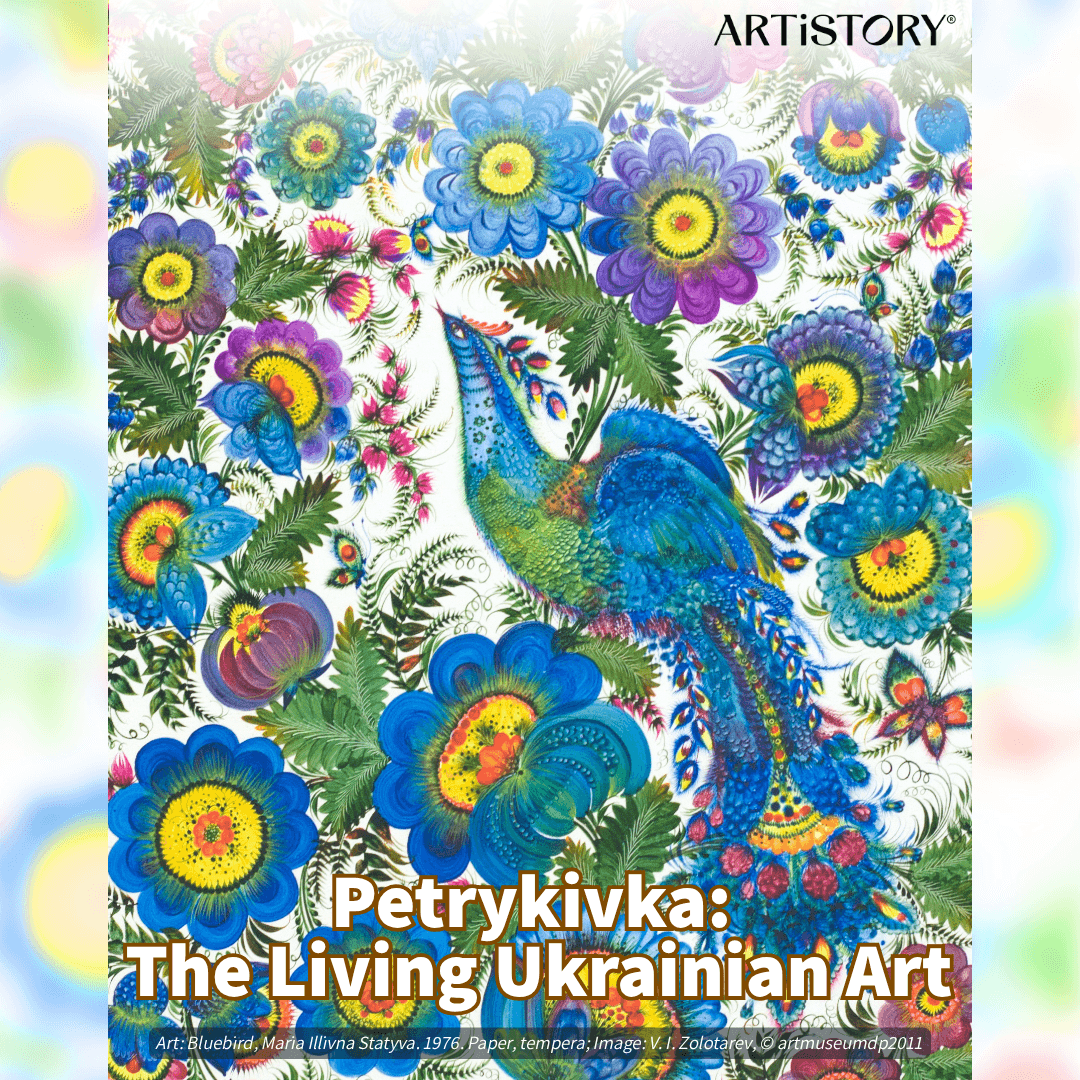
Title EN: Bluebird, Maria Illivna Statyva. 1976. Paper, tempera
Title as submitted EN: А demonstrative example ofpaper "painting" where the floral and ornamental forms are combined with а stylized depiction of fancy Ьігd. This combination of decorative elements is typical of the tгade masters. The author of this work is М.І. Statyva гepгesenting а modern geneгation оf masteгs of the Petгykivka style of painting.
Photograph: V. I. Zolotarev; © artmuseumdp2011
That combination gives the art its emotional rhythm. Flowers are often associated with flourishing. Birds are commonly interpreted as movement, song, and protection. Berries often bring associations of fertility and seasonal abundance. The white ground, historically associated with whitewashed walls and paper, gives the motifs room to breathe. Even when contemporary artists work on black, blue, green, or red grounds, the feeling of luminous ornament remains central.
Technique as cultural knowledge
The craft is also carried through technique. Petrykivka painters are known for distinctive brushwork, including strokes often translated as comb, seed, nut, and transitional stroke. Many elements can be created with a single movement of the brush, while berries may be applied with the fingertip to create a rounded form with a lighter center and darker edge. Professional practitioners are often described as composing mentally before painting, rather than relying on measured outlines.
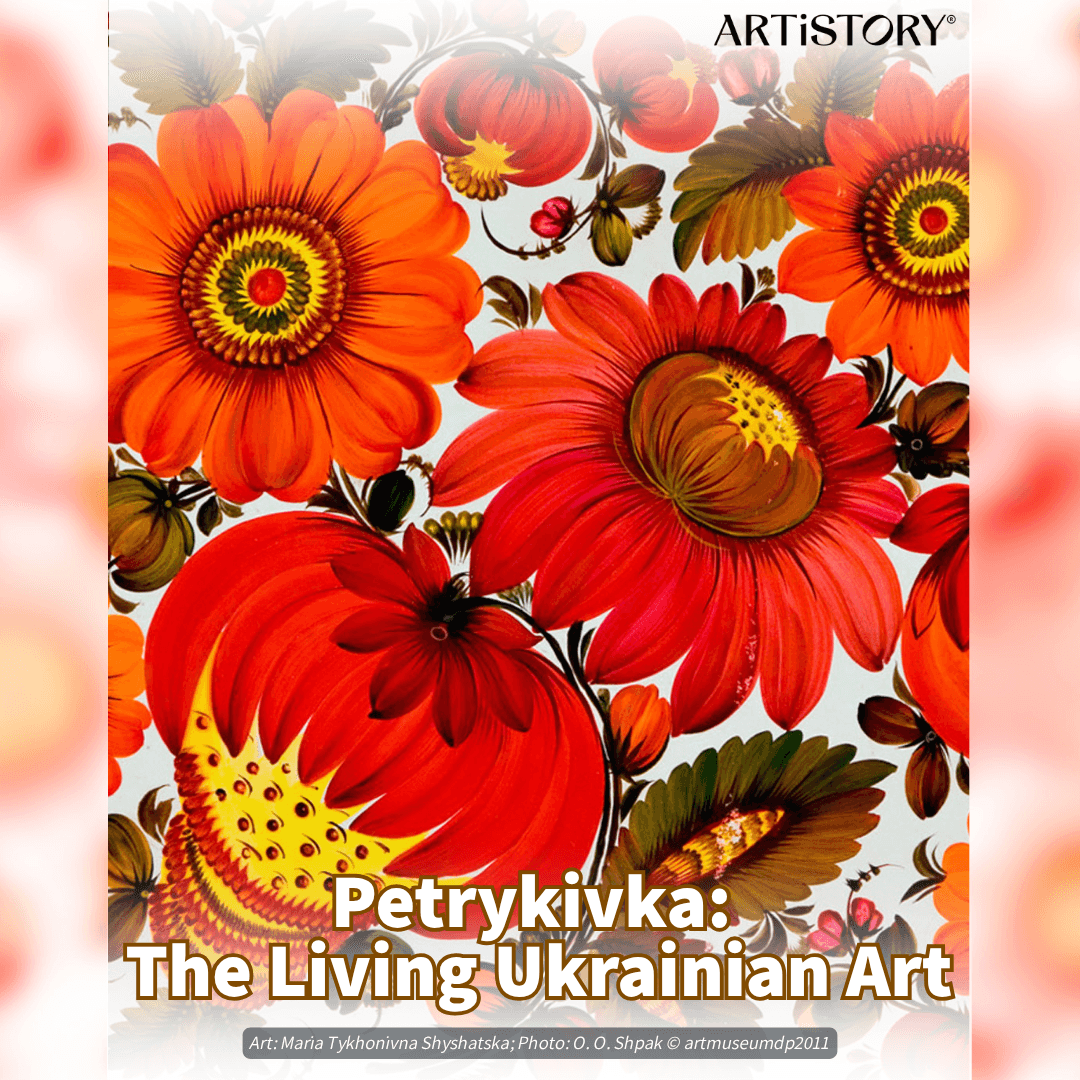
Title EN: Decorative panel picture, Maria Tykhonivna Shyshatska. 1976. Paper, tempera
Title as submitted EN: А demonstrative example of paper ''painting" with the use of а floral decoгative ornament chaгacteгistic of the Petrykivka style of painting. The author of this work is М. Т. Shyshatska гepresenting а geneгation of the masteгs of the Petrykivka style of painting of the eighties of the ХХth century.
Photograph: O. O. Shpak; © artmuseumdp2011
This matters because technique is part of the heritage. The line is not merely decorative; it is evidence of training, memory, hand control, and intergenerational transmission. A responsible contemporary interpretation should therefore respect both the motif and the method behind it.
Recognition and living heritage
Petrykivka was recognized by Ukraine's Ministry of Culture as intangible cultural heritage in 2012 and was inscribed on UNESCO's Representative List of the Intangible Cultural Heritage of Humanity in 2013 under the title Petrykivka decorative painting as a phenomenon of the Ukrainian ornamental folk art. The UNESCO recognition is important because it acknowledges Petrykivka as a living practice, not simply a historical style.
In this context, living heritage means that the tradition is carried by people: makers, teachers, families, schools, workshops, communities, and contemporary artists. It can evolve, but it should not be emptied of its cultural identity. The story of Petrykivka is therefore a story of Ukrainian resilience, regional creativity, and the power of ornament to hold memory.
Why Petrykivka still speaks to contemporary audiences
Petrykivka feels contemporary because it combines clarity with emotion. Its motifs are bold enough to travel across products, media, and environments, yet detailed enough to reward close looking. It connects botanical beauty with optimism, craft skill with cultural belonging, and local identity with global recognition.
For modern readers, the art offers three kinds of meaning: visual joy, cultural rootedness, and human touch. In a design world often shaped by digital repetition, Petrykivka reminds us that a line made by hand can carry memory.
Commercial Angle: How ARTiSTORY can help licensees approach Petrykivka responsibly
For licensees, Petrykivka has strong potential across home decor, stationery, gifting, packaging, fashion accessories, beauty, food and beverage campaigns, cultural pop-ups, and educational retail. The opportunity, however, should not begin with pattern extraction. It should begin with the culture: maker context, rights, community meaning, and a story-first point of view, with appropriate permissions and cultural approvals confirmed before commercial use.
This is where ARTiSTORY can support brands, where relevant rights and partnerships are available. Through merchandise licensing, promotion licensing, experience licensing, and purpose-led cultural positioning through ARTiSTORY's social causes framework, ARTiSTORY can help licensees move from admiration to more informed, culturally careful application.
The strongest commercial use of Petrykivka is not a surface print that simply signals "folk." It is a collaboration that helps the audience understand why the flowers, birds, berries, and brushstrokes matter. ARTiSTORY can help shape that journey through cultural research, rights coordination, motif interpretation, product and packaging direction, retail storytelling, campaign copy, and partner-facing content, without implying confirmed representation or approvals unless those agreements are in place.
Conclusion
Petrykivka endures because it makes culture visible in everyday life. Its flowers are not only flowers. Its birds are not only birds. They are commonly read as signs of care, renewal, home, and continuity. When approached with respect, the tradition offers brands a rare opportunity: to create products and experiences that do not simply borrow beauty, but carry a story forward with appropriate cultural and rights guidance.
FAQ
What is Petrykivka?
Petrykivka is a Ukrainian decorative painting tradition associated with the village of Petrykivka in Dnipropetrovsk Oblast. It is known for floral motifs, birds, berries, rhythmic brushwork, and a strong connection to everyday domestic decoration.
Why is Petrykivka culturally significant?
It is significant because it is a living Ukrainian craft tradition that preserves regional identity, intergenerational skill, and symbolic ornamental language. Petrykivka decorative painting was inscribed on UNESCO's Representative List of the Intangible Cultural Heritage of Humanity in 2013.
What motifs are common in Petrykivka?
Common motifs include flowers, leaves, berries, birds, and sometimes fantastical creatures such as the firebird. These elements are often associated with vitality, abundance, movement, and protection, though meanings can vary by maker, context, and interpretation.
Can Petrykivka be used in contemporary products?
Yes, but responsible use should be guided by cultural context, rights, maker involvement where appropriate, and respectful storytelling. ARTiSTORY can help licensees shape this kind of story-first approach where appropriate rights, permissions, and partnerships are in place.


Back to Home

Connecting cultures through meaningful brand collaborations and authentic storytelling that drives both impact and revenue.
" height="15.00095079498291px" id="KzAesqen_" width="15.887237074279785px"/></svg>)
" height="40px" id="PdXwlesgs" width="40px"/></svg>)
" height="16.6667px" id="bN179avM0" width="16.66250000000001px"/></svg>)
" height="40px" id="sK1n39Y12" width="40px"/></svg>)
" height="13.333300000000001px" id="e3sm3FX65" width="16.662000000000006px"/></svg>)
" height="40px" id="BlhXMiVl0" width="40px"/></svg>)
" height="16.666358956956856px" id="WrXlTUAw7" width="16.668330260537772px"/></svg>)
" height="40px" id="nKu2x0iOq" width="40px"/></svg>)
Services
© 2026 ARTiSTORY. All rights reserved.
Privacy Policy
Terms of Service
Cookie Policy