
Back to Stories
Living Threads: Indonesia’s Batik Heritage
Key Takeaway
Recognized by UNESCO in 2009, Indonesian batik is a wax-resist textile tradition that encodes regional identity, philosophy, and centuries of cross-cultural exchange. Sustained by family workshops and heritage programs, it remains both everyday clothing and national symbol, offering rich potential for respectful, artisan-led collaborations in global fashion and design.
About ARTiSTORY
ARTiSTORY offers a demand-driven portfolio of art and cultural IP, empowering brands, retailers, and venues to create authentic, culture-rich products and experiences. With access to over 170 million artifacts and artworks, as well as 30+ UNESCO-recognized intangible cultural heritages, we help our partners attract consumers drawn to art, culture, and meaning. Please refer to Our Works to see what ARTiSTORY worked with Dunhuang Mogao Cave and fashion brand Levi's.
UNESCO Intangible Cultural Heritage
ARTiSTORY Staff
• 3 minute read
On Java’s busy streets and in quiet village workshops, Indonesia’s batik tells stories in wax and dye long before a single word is spoken. Each cloth begins as plain fabric, but through a patient process of drawing, dipping, and re-dyeing, it becomes a living archive of beliefs, social values, and local identity. In 2009, UNESCO recognized Indonesian batik as an Intangible Cultural Heritage of Humanity, acknowledging not only its beauty but also the deep knowledge and creativity woven into every motif.
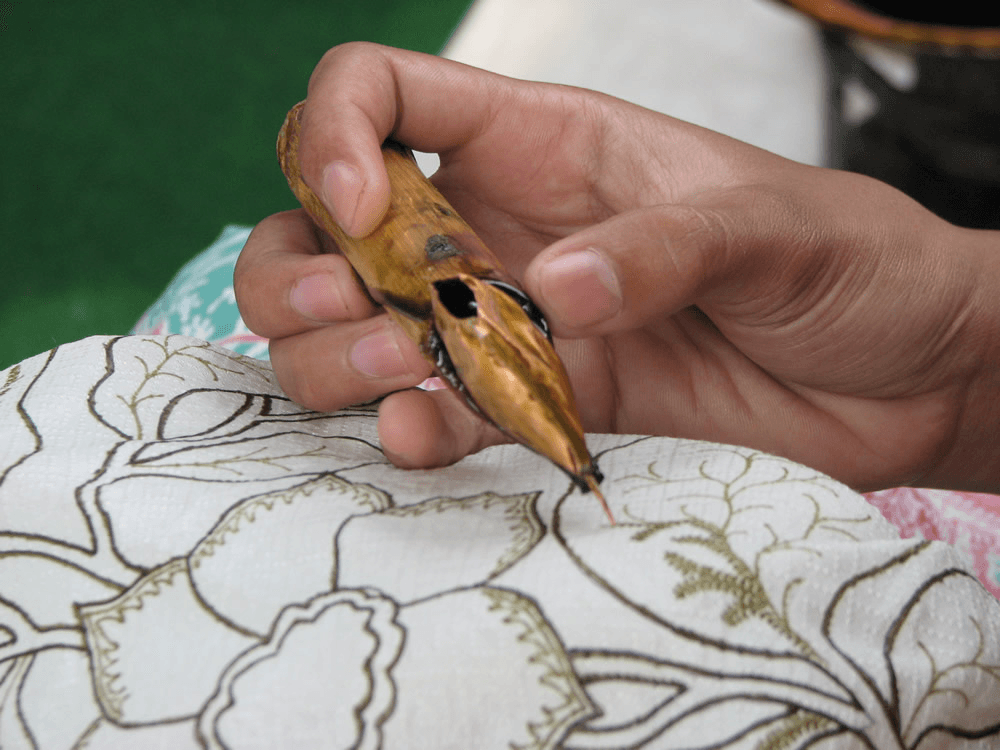
Batik is created through a wax-resist technique: artisans apply melted wax in intricate lines and dots onto cloth, then immerse it in dye so that only the unwaxed sections absorb color. Once the wax is removed, delicate patterns emerge, often in multiple layers of color built up through repeated waxing and dyeing. Some artisans use a canting, a small copper pen with a spout that allows wax to flow like ink, while others work with carved copper stamps called cap to speed up the creation of repeating designs. This method is not simply a craft process; it encodes generations of experimentation with tools, dyes, and design.
Indonesian Batik: Hand drawing batik using a canting tulis to apply wax‑resist to cloth.
00170_en_Photograph_Gaura-Mancaccariladipura_2008
Creator: Gaura Mancaccariladipura.
Place of production: Batik Museum Institute, Pekalongan, Central Java, Indonesia.
Image: UNESCO Intangible Cultural Heritage of Humanity collection for element 00170 “Indonesian Batik.”
Across Indonesia, batik patterns carry a remarkable diversity of influences. UNESCO notes that motifs may feature Arabic calligraphy, European floral bouquets, Chinese phoenixes, Japanese cherry blossoms, and Indian or Persian peacocks, reflecting centuries of trade and cultural exchange. In central Javanese courts such as Yogyakarta and Solo, traditional patterns like parang and kawung are closely tied to codes of etiquette and status. The parang motif, with its diagonal, wave-like forms, symbolizes resilience and the continuous effort to overcome life’s challenges, while kawung’s concentric ovals suggest balance, purity, and self-control.
In coastal cities like Pekalongan and Cirebon, batik takes on a brighter, bolder character. Research on regional batik heritage notes that coastal batik embraces strong primary and secondary colors, vivid contrasts, and motifs inspired by the sea and international trade. Here, the cloth records encounters with foreign merchants and migrating artistic ideas, transforming them into distinctly Indonesian designs. In every region, patterns are not merely decorative; they function as visual language indicating where a wearer comes from, the occasion being marked, or the values the community holds dear.
The recognition by UNESCO in 2009 was both a celebration and a call to action. It affirmed that batik is more than a textile—its practice is intertwined with rituals, community gatherings, and the transfer of knowledge from elders to younger generations. Artisans often learn from family members in small, home-based workshops, where children observe the careful handling of wax, the mixing of dyes, and the unwritten rules of how certain motifs are worn. This continuity is fragile, however, facing pressure from mass-produced imitations and shifting consumer habits. Heritage programs in Indonesia now work to document traditional techniques, support artisan cooperatives, and encourage younger people to take up batik-making as a viable livelihood.
Today, batik operates on two interconnected stages. Locally, it remains central to ceremonies, from weddings and coming-of-age rituals to state occasions, where carefully chosen motifs signal respect for tradition. Internationally, batik has become a symbol of Indonesia itself, worn by diplomats and designers, and adopted in global fashion as a marker of craftsmanship and cultural depth. This dual life—as everyday dress and as national icon—shows how a heritage craft can adapt to modern markets without losing its soul, as long as the communities who created it continue to lead its story.
Commercial application
Batik’s symbolic motifs and regional color stories lend themselves to capsule collections in fashion, home décor, and stationery, especially when co-created with Indonesian artisans and labeled with UNESCO heritage storytelling, ensuring both authentic design and shared economic benefit.
ARTiSTORY offers a demand‑driven portfolio of art and cultural IP, empowering brands, retailers, and venues to create authentic, culture‑rich products and experiences. With access to over 170 million artifacts and artworks, as well as 30+ UNESCO‑recognized intangible cultural heritages, we help our partners attract consumers drawn to art, culture, and meaning. Please refer to Our Works to see what ARTiSTORY worked with Dunhuang Mogao Cave and fashion brand Levi’s.
Back to Home

Connecting cultures through meaningful brand collaborations and authentic storytelling that drives both impact and revenue.
" height="15.00095079498291px" id="KzAesqen_" width="15.887237074279785px"/></svg>)
" height="40px" id="PdXwlesgs" width="40px"/></svg>)
" height="16.6667px" id="bN179avM0" width="16.66250000000001px"/></svg>)
" height="40px" id="sK1n39Y12" width="40px"/></svg>)
" height="13.333300000000001px" id="e3sm3FX65" width="16.662000000000006px"/></svg>)
" height="40px" id="BlhXMiVl0" width="40px"/></svg>)
" height="16.666358956956856px" id="WrXlTUAw7" width="16.668330260537772px"/></svg>)
" height="40px" id="nKu2x0iOq" width="40px"/></svg>)
Services
© 2026 ARTiSTORY. All rights reserved.
Privacy Policy
Terms of Service
Cookie Policy