
Back to Stories
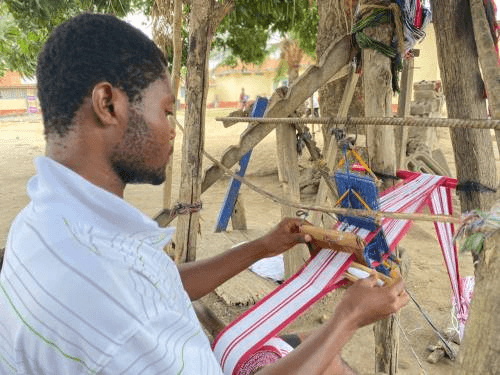
© National Folklore Board, Ghana, 2023
Kente Cloth: Ghana’s Living Heritage of Woven Meaning
Key Takeaway
Kente cloth is one of Ghana’s most recognizable cultural textiles, but its significance goes far beyond color and pattern. In 2024, UNESCO inscribed “Craftsmanship of traditional woven textile Kente” on the Representative List of the Intangible Cultural Heritage of Humanity, recognizing the weaving knowledge, social meanings, transmission systems, and community practices behind the cloth (UNESCO ICH). For brands and cultural institutions, responsible engagement with Kente begins with respect: learn the context, work with legitimate knowledge holders, secure informed consent, give attribution, share benefits, and avoid reducing a living heritage to a decorative motif.
About ARTiSTORY
ARTiSTORY offers a demand-driven portfolio of art and cultural IP, empowering brands, retailers, and venues to create authentic, culture-rich products and experiences. With access to over 170 million artifacts and artworks, as well as 30+ UNESCO-recognized intangible cultural heritages, we help our partners attract consumers drawn to art, culture, and meaning. Please refer to Our Works to see what ARTiSTORY worked with Dunhuang Mogao Cave and fashion brand Levi's.
UNESCO Intangible Cultural Heritage
ARTiSTORY Staff
• 6 minute read
Kente Cloth: Ghana’s Living Heritage of Woven Meaning
What Is Kente Cloth?
Kente is a Ghanaian handwoven textile made from strips woven from silk, cotton, or rayon on horizontal looms (UNESCO ICH). These strips are assembled into larger cloths whose colors, designs, and names can carry social, historical, philosophical, and ceremonial meanings.
UNESCO notes that the age, social status, and gender of users can influence the choice of color and design, and that finished Kente products may be named with proverbs, sayings, and social situations (UNESCO ICH). In this sense, Kente functions not simply as surface design, but as a form of communication and identity construction.
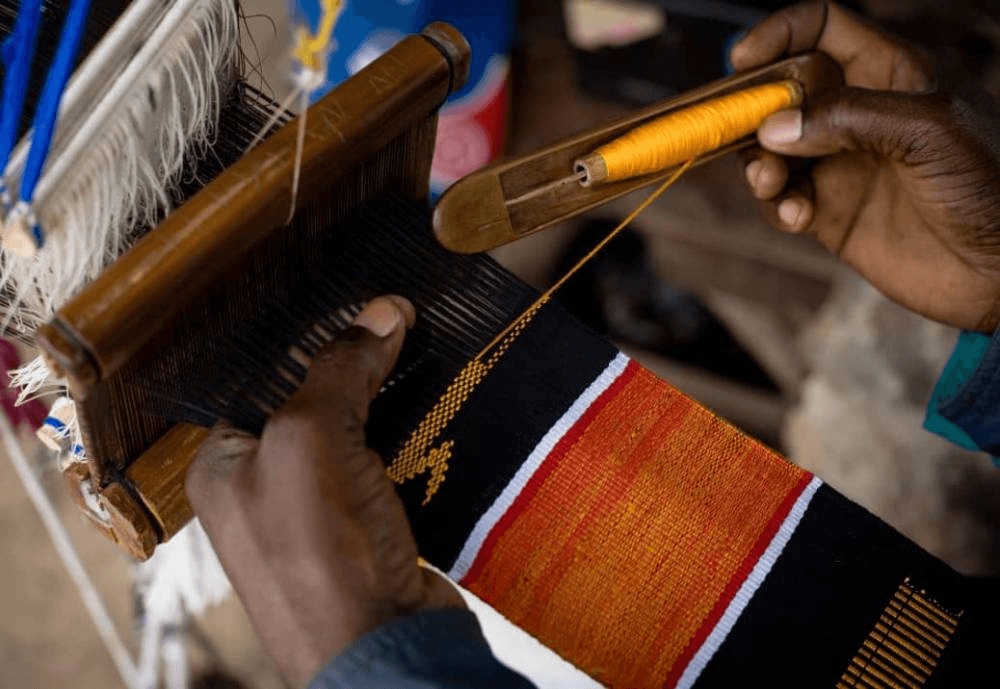
Kente is one of the handwoven textiles made in Ghana
Photograph: Thompson Avornyotse
© National Folklore Board, Ghana, 2023
The craft is sustained through families, master-weaver apprenticeships, high school and tertiary education, exhibitions, museums, workshops, festivals, and literary sources (UNESCO ICH). Its continuity depends on both inherited knowledge and the ongoing creativity of weavers.
Why Kente Is Intangible Cultural Heritage
UNESCO inscribed “Craftsmanship of traditional woven textile Kente” in 2024 during the 19.COM cycle, recognizing Ghana’s nomination No. 02130 for the Representative List of the Intangible Cultural Heritage of Humanity (UNESCO Decision 19.COM 7.B.38). This recognition places attention not only on the finished textile, but on the living practices that make the textile meaningful.
Kente’s intangible heritage value lies in the knowledge system behind it: loom preparation, strip weaving, color selection, pattern development, naming, social use, and transmission across generations. UNESCO describes the craft as a means of communication, information exchange, and identity construction that reflects the social histories of communities (UNESCO ICH).
Safeguarding measures named in UNESCO’s decision include museum exhibitions, practitioner workshops, festivals, trade fairs, education, public-private partnerships, publications, and the creation of craft families, cooperatives, and associations (UNESCO Decision 19.COM 7.B.38). These measures matter because living heritage survives through people, practice, learning, and fair cultural visibility.
The People Behind the Cloth
Kente is sustained by communities of producers, master weavers, families, educators, and cultural custodians. UNESCO notes that each community of producers is led by a chief weaver who regulates production standards, resolves conflicts among weavers, and establishes networks for knowledge acquisition and trade (UNESCO ICH).
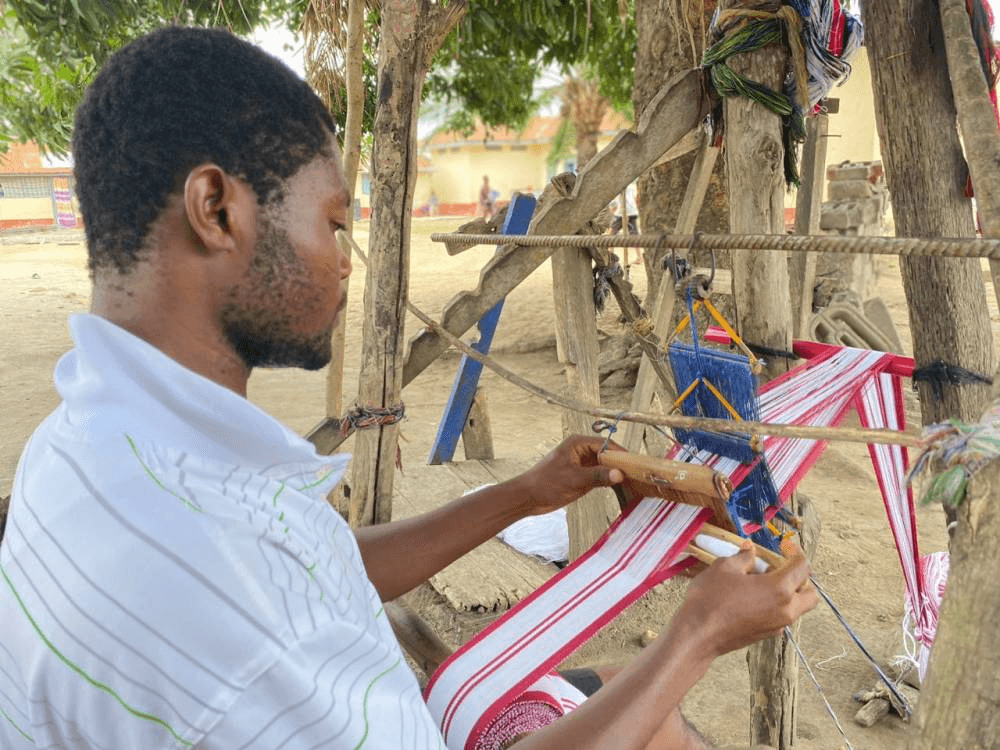
Weaver weaving a strip of Kente. Here he passes the loaded weft shuttle through the partition made by the hurdles and he pulls his legs upwards and downwards. With the beater, he beats the woven yarns for a firm hold.
Photograph: Thompson Avornyotse
© National Folklore Board, Ghana, 2023
This point is essential for responsible storytelling. Kente should not be presented as an anonymous pattern library. It is a living practice held by people whose knowledge, authority, and creative contribution should remain visible in any cultural or commercial interpretation.
Why Responsible Use Matters
Kente is often recognized globally by its vibrant geometry, but recognition can easily become flattening when the cloth is described only as “African-inspired” or used without reference to its Ghanaian cultural context. WIPO describes Traditional Cultural Expressions as forms through which traditional culture is expressed, including designs, names, signs, symbols, handicrafts, narratives, performances, and ceremonies that form part of community identity and heritage (WIPO Traditional Cultural Expressions).
For a brand, this means that cultural research alone is not enough. Ethical use requires relational work: identifying legitimate knowledge holders, understanding whether a design or symbol is suitable for public adaptation, negotiating consent, acknowledging the source community, and sharing benefits.
UNESCO’s ethical principles state that communities should have the primary role in safeguarding their intangible cultural heritage, and that interactions should be based on transparent collaboration, dialogue, negotiation, consultation, and free, prior, sustained and informed consent (UNESCO Ethics and ICH). The same principles state that communities should benefit from the moral and material interests arising from the use, research, documentation, promotion, or adaptation of their heritage (UNESCO Ethics and ICH).
Commercial Use Without Cultural Backlash
Responsible Kente-inspired product development should begin with a simple question: are we using this heritage as decoration, or are we building a respectful cultural relationship?
WIPO’s fashion guidance recommends researching cultural context, identifying legitimate holders or custodians, building relationships and trust, reaching written agreements based on prior and informed consent, giving acknowledgement and attribution, and sharing benefits with the community (WIPO Fashion and TCE Guidance). For Kente, those steps translate into a clear commercial-use protocol.
Responsible Kente Use Checklist
Use precise language: Say “Kente cloth” or “Ghanaian Kente weaving” when referring to the heritage. Avoid vague labels such as “tribal,” “ethnic print,” or generic “African pattern.”
Verify source and production method: If using actual cloth, confirm whether it is handwoven, where it was produced, who produced it, and what standards or certifications apply.
Secure cultural consent: Work through recognized weavers, community representatives, cultural custodians, or appropriate Ghanaian cultural institutions before adapting meaningful motifs, names, or ceremonies.
Document the license: Use written agreements that define design scope, product categories, territories, duration, approvals, attribution, royalties, moral rights, and benefit sharing.
Respect restricted meanings: Some symbols, names, colors, ceremonies, or uses may be inappropriate for mass-market products. If community advisors say no, the answer is no.
Attribute visibly: Product pages, hangtags, campaign copy, press materials, and in-store displays should name the source tradition and acknowledge collaborating makers or communities where agreed.
Share benefits fairly: Benefits may include royalties, license fees, artisan payments, community funds, education support, co-authorship, training, or long-term sourcing commitments.
Avoid misleading authenticity claims: Do not call a product “authentic Kente” unless it meets the applicable production, origin, and rights-clearance requirements.
Invite community review: Before launch, allow cultural collaborators to review key copy, visuals, product naming, and campaign context.
ARTiSTORY Perspective
At ARTiSTORY, cultural IP licensing begins with the belief that heritage is not a visual shortcut. It is a living relationship between story, maker, place, practice, and audience.
Kente offers a powerful example. Its beauty is immediately visible, but its deeper value lies in the knowledge system behind the cloth: the hands at the loom, the naming of designs, the role of ceremony, the authority of communities, and the continuity of transmission. When approached responsibly, Kente can inspire cultural education, meaningful design, and respectful commercial storytelling. When approached carelessly, it risks becoming another example of heritage separated from its source.
Responsible cultural licensing protects more than a product. It protects the dignity of the tradition, the role of its bearers, and the trust between culture and market.
FAQ
What is Kente cloth?
Kente is a Ghanaian textile made from strips woven from silk, cotton, or rayon on horizontal looms, with colors and designs that can reflect social meaning, identity, proverbs, sayings, and community histories (UNESCO ICH).
Is Kente cloth UNESCO intangible cultural heritage?
Yes. UNESCO inscribed “Craftsmanship of traditional woven textile Kente” on the Representative List of the Intangible Cultural Heritage of Humanity in 2024 (UNESCO ICH).
Why is Kente considered living heritage?
Kente is considered living heritage because it includes not only finished textiles, but also weaving skills, design knowledge, naming traditions, social meanings, community standards, apprenticeships, family transmission, and educational practices (UNESCO ICH).
Can brands use Kente patterns commercially?
Brands should not treat Kente as a generic pattern. Responsible commercial use requires cultural due diligence, engagement with legitimate knowledge holders, prior and informed consent, written agreements, attribution, and benefit sharing, in line with UNESCO ethical principles and WIPO guidance on traditional cultural expressions (UNESCO Ethics and ICH; WIPO Fashion and TCE Guidance).
How can a brand avoid cultural appropriation when referencing Kente?
A brand can reduce risk by naming the Ghanaian context clearly, avoiding sacred or restricted motifs without permission, collaborating with legitimate cultural custodians, paying makers fairly, using written licenses, giving visible attribution, and letting community collaborators review final usage before launch (WIPO Fashion and TCE Guidance).
Back to Home

Connecting cultures through meaningful brand collaborations and authentic storytelling that drives both impact and revenue.
" height="15.00095079498291px" id="KzAesqen_" width="15.887237074279785px"/></svg>)
" height="40px" id="PdXwlesgs" width="40px"/></svg>)
" height="16.6667px" id="bN179avM0" width="16.66250000000001px"/></svg>)
" height="40px" id="sK1n39Y12" width="40px"/></svg>)
" height="13.333300000000001px" id="e3sm3FX65" width="16.662000000000006px"/></svg>)
" height="40px" id="BlhXMiVl0" width="40px"/></svg>)
" height="16.666358956956856px" id="WrXlTUAw7" width="16.668330260537772px"/></svg>)
" height="40px" id="nKu2x0iOq" width="40px"/></svg>)
Services
© 2026 ARTiSTORY. All rights reserved.
Privacy Policy
Terms of Service
Cookie Policy