
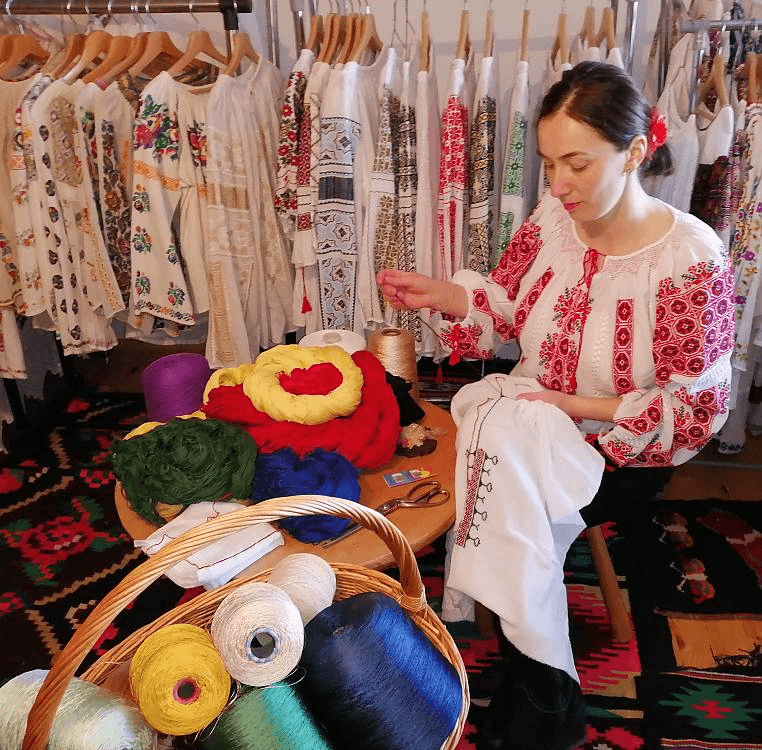
An artisan meticulously hand-embroiders an altiță—the traditional Romanian and Moldovan blouse. Credit: © UNESCO / National Heritage Institute of Romania. © Damian Dumitru Laurenţiu/Video Art Studio, 2021
Yves Saint Laurent, Henri Matisse, and the Romanian Blouse
Key Takeaway
Yves Saint Laurent's Autumn-Winter 1981 Haute Couture drew directly from Henri Matisse's La Blouse Roumaine (1940) — and from the Romanian ia tradition behind it. YSL gave full credit. He returned in 1999. Across 40 years, his engagement with the Romanian blouse remained consistent, attributed, and respectful. The Romanian ia (ie/ia/altiță) was inscribed by UNESCO in December 2022. ARTiSTORY curates its IP for brands ready to follow YSL's standard.
About the Author
ARTiSTORY offers a demand-driven portfolio of art and cultural IP, empowering brands, retailers, and venues to create authentic, culture-rich products and experiences. With access to over 170 million artifacts and artworks, as well as 30+ UNESCO-recognized intangible cultural heritages, we help our partners attract consumers drawn to art, culture, and meaning. Please refer to Our Works to see what ARTiSTORY worked with Dunhuang Mogao Cave and fashion brand Levi's.
News
ARTiSTORY Staff
• 3 minute read
The 40-Year Standard: Yves Saint Laurent, Henri Matisse, and the Romanian Blouse
The Romanian Ia — A Living Art Form
The Romanian ia — called ie in some regions, ia in others, and always anchored by its altiță (the embroidered band at the shoulder) — is a garment that is also a grammar. It was inscribed on UNESCO's Representative List of the Intangible Cultural Heritage of Humanity in December 2022 as Element 01861, jointly held by Romania and the Republic of Moldova.
Each region writes its own sentences in that grammar. Muntenia favors dense floral embroidery. Moldavia leans into geometric precision and richly worked cuffs. Oltenia's ia often carries metal thread and distinctive chromatic palettes. The stitches carry coded information about family, region, marital status, and age — knowledge that, for centuries, has been transmitted almost entirely from mother to daughter.
Since 2013, June 24 has been observed as the Universal Day of the Romanian Blouse, an initiative that now draws public celebrations in more than 60 countries. The ia is both a garment and an identity marker — a living art form, not a museum object.
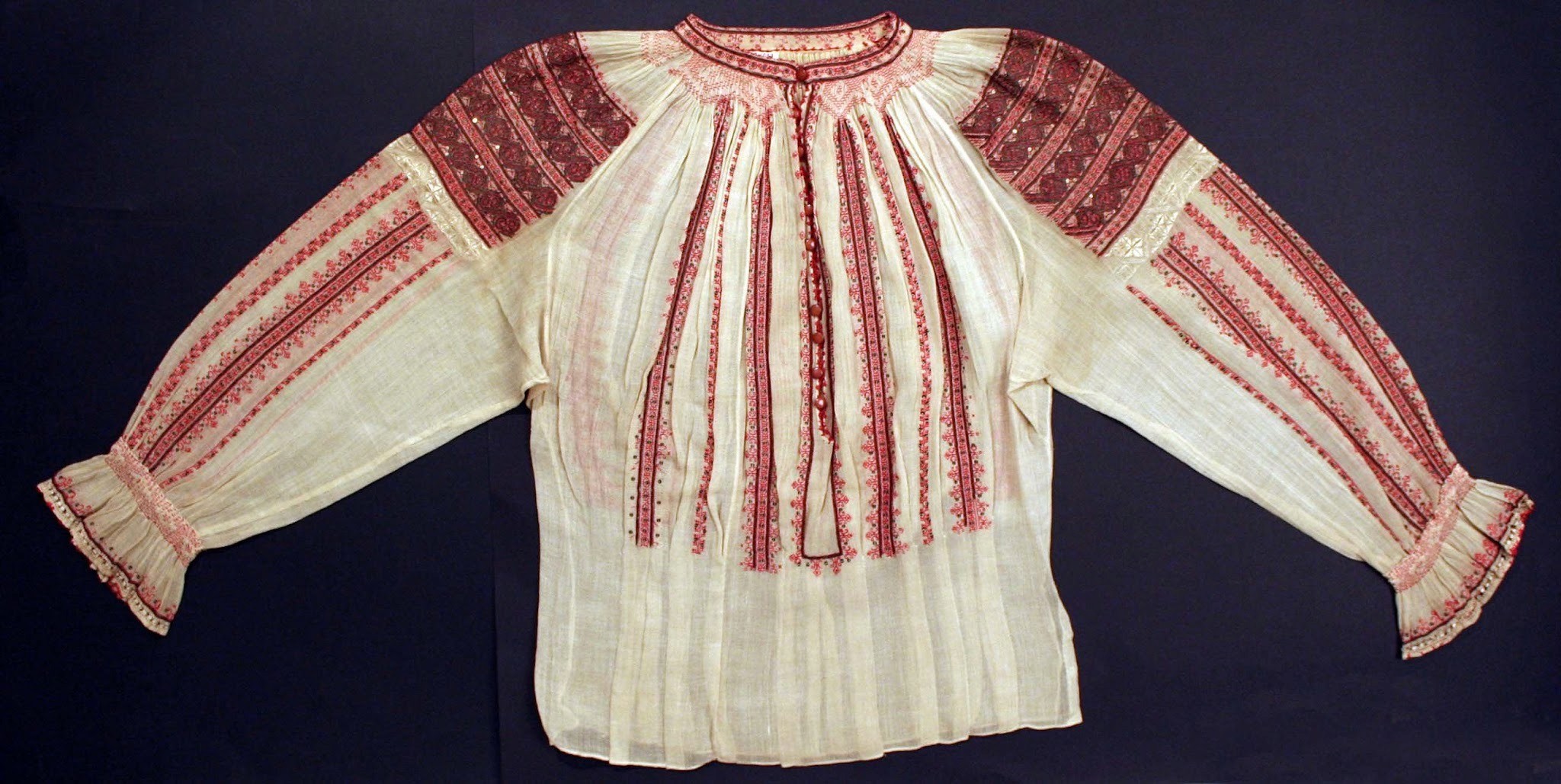
Romanian blouse (ia), late 19th century. Cotton, silk, and metal thread. Metropolitan Museum of Art (from the Brooklyn Museum Costume Collection). MET Open Access — CC0 Public Domain.
Henri Matisse and the Romanian Blouse
Matisse's encounter with the Romanian blouse was intimate before it was artistic. He owned one. He wore it himself. He painted it — repeatedly, across several canvases — until La Blouse Roumaine (1940), now in the collection of the Musée National d'Art Moderne at the Centre Pompidou (Inv. AM 3245 P), became one of the defining works of his late career.
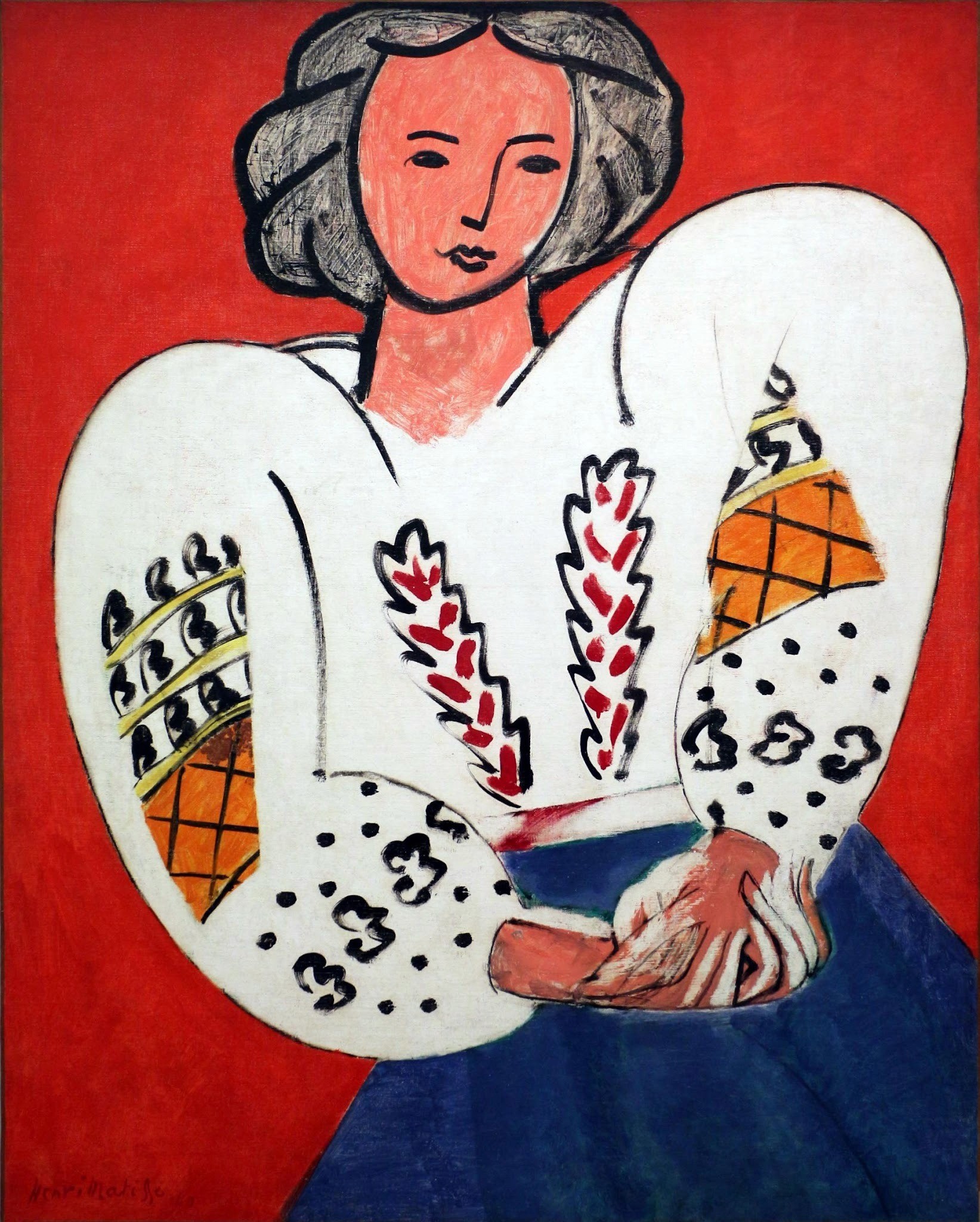
Henri Matisse, La Blouse Roumaine (The Romanian Blouse), April 1940. Oil on canvas, 92 × 73 cm. Musée National d'Art Moderne, Centre Pompidou, Paris (Inv. AM 3245 P). Photo: Philippe Migeat / Centre Pompidou, MNAM-CCI / Dist. GrandPalaisRmn. Wikimedia Commons (CC BY-SA 4.0). © Succession H. Matisse.
What drew a French modernist to a Romanian folk garment? The altiță's geometric precision — its flattening of form into color and pattern — mirrored Matisse's own aesthetic concerns. He was not quoting a costume; he was recognizing a shared visual language. The ia, in his hands, became a bridge between village tradition and the 20th-century Western fine-art canon, without either losing its authorship.
Yves Saint Laurent — 40 Years of Credit
When Yves Saint Laurent presented his Autumn-Winter 1981 Haute Couture collection, he named Matisse as his source — and through Matisse, named Romania. The 1981 ensemble, now displayed at the Musée Yves Saint Laurent in Paris, makes the lineage visible: wide sleeves, embroidered shoulder bands, the silhouette of the ia translated into couture.
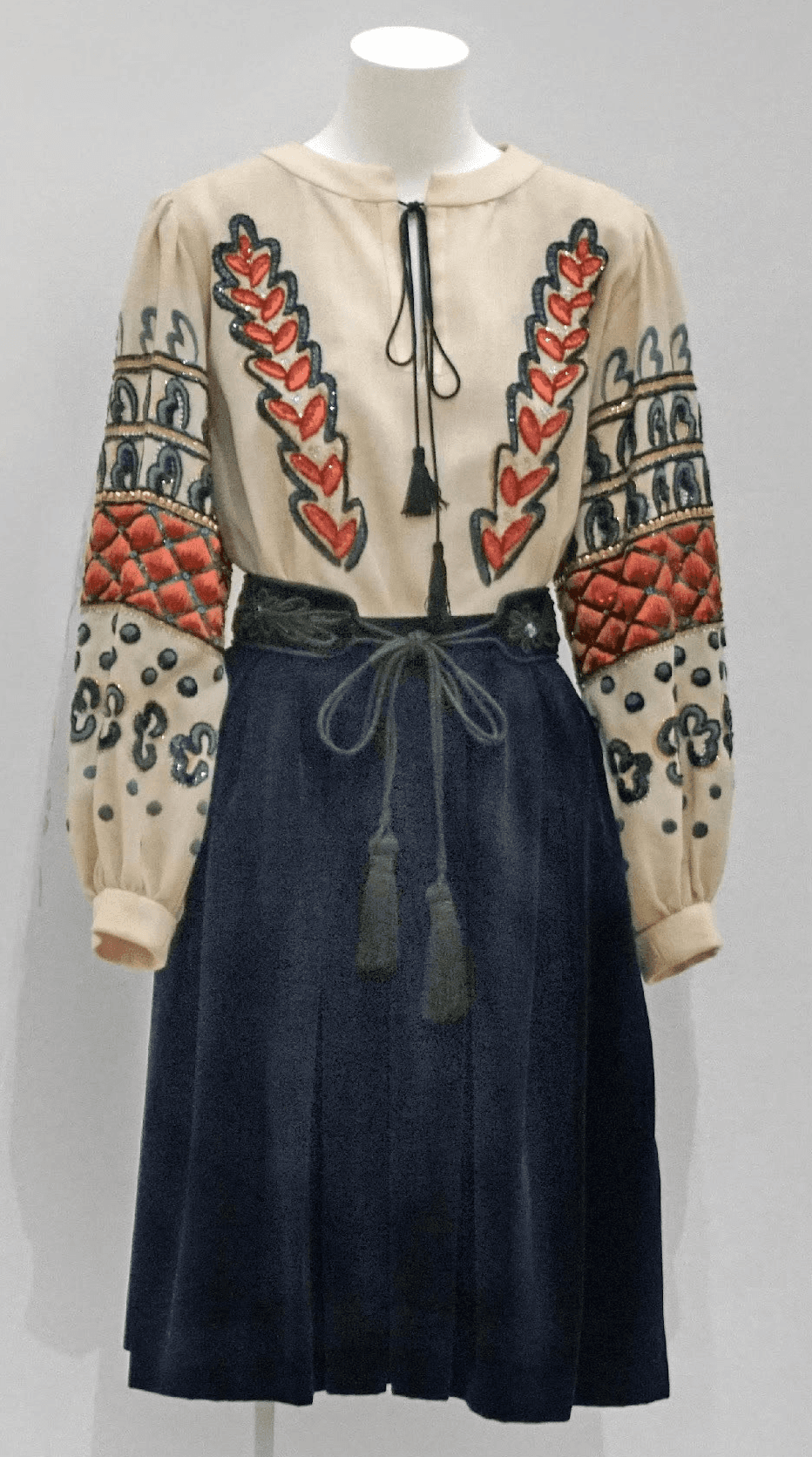
Yves Saint Laurent, Autumn-Winter 1981 Haute Couture. Ensemble inspired by Henri Matisse's La Blouse Roumaine (1940), displayed at Musée Yves Saint Laurent, Paris. Photo: Jean-Pierre Dalbera / Wikimedia Commons (CC BY 2.0).
YSL himself framed the engagement plainly: “A Romanian blouse does not belong to any period. All the peasant clothes are passed down from century to century without going out of fashion.”
He returned to the Romanian ia in Autumn-Winter 1999–2000 Haute Couture. Two decades apart, the same tradition, the same credit. This is not trend-chasing. It is genuine cultural engagement — the kind of sustained relationship that creates better fashion history than borrowed aesthetics ever can.
Andreea Tănăsescu, founder of La Blouse Roumaine, summarizes the model: “YSL introduced in haute couture the Romanian take and many other inspirations from traditional cultures of the world, but always credited them.”
Why Attribution Is the Standard, Not the Exception
The contemporary GiveCredit movement — and the wider conversation around cultural IP in fashion — exists precisely because credited engagement has too often been the exception rather than the rule. When traditions are lifted without attribution, communities lose authorship, economic benefit, and narrative control. When they are engaged with credit, the opposite is true: the tradition is strengthened, the community benefits, and the brand earns a cultural depth that no amount of marketing can replicate. ARTiSTORY's model exists to make the credited, licensed, practitioner-connected path the easy default — not the exception.
ARTiSTORY and the Romanian Blouse IP Portfolio
ARTiSTORY curates the Romanian Blouse IP portfolio with proper attribution and practitioner-community engagement built in from the first conversation. We connect brands to the ia as YSL connected to it: with credit, with continuity, and with the reverence the tradition deserves.
FAQ
Q1: What is the Romanian blouse (ia/ie)?
The ia is a traditional Romanian blouse, typically white linen or cotton, defined by the altiță — an embroidered band at the shoulder — along with embroidered cuffs and bodice patterns. It carries coded regional, family, and social meaning.
Q2: When was the Romanian blouse inscribed by UNESCO?
In December 2022, as UNESCO Intangible Cultural Heritage Element 01861, jointly held by Romania and the Republic of Moldova.
Q3: What is Henri Matisse's connection to the Romanian blouse?
Matisse owned and wore a Romanian ia and painted it repeatedly. La Blouse Roumaine (1940), at Centre Pompidou, is one of his most celebrated late works.
Q4: How did Yves Saint Laurent use the Romanian blouse in his collections?
YSL cited Matisse's La Blouse Roumaine and the Romanian ia directly in his Autumn-Winter 1981 Haute Couture collection, and returned to the Romanian blouse in Autumn-Winter 1999–2000 Haute Couture. Both times, he gave full credit.
Q5: How can brands license Romanian blouse motifs through ARTiSTORY?
ARTiSTORY curates the Romanian Blouse IP portfolio for brand partners — providing licensed, attributed access to motifs, narratives, and practitioner-community connections. Contact ARTiSTORY to begin.

ARTiSTORY helps brands turn the right cultural source into validated concepts, production-ready design assets and market-ready storytelling.
" height="15.00095079498291px" id="KzAesqen_" width="15.887237074279785px"/></svg>)
" height="40px" id="PdXwlesgs" width="40px"/></svg>)
" height="16.6667px" id="bN179avM0" width="16.66250000000001px"/></svg>)
" height="40px" id="sK1n39Y12" width="40px"/></svg>)
" height="13.333300000000001px" id="e3sm3FX65" width="16.662000000000006px"/></svg>)
" height="40px" id="BlhXMiVl0" width="40px"/></svg>)
" height="16.666358956956856px" id="WrXlTUAw7" width="16.668330260537772px"/></svg>)
" height="40px" id="nKu2x0iOq" width="40px"/></svg>)
Services
© 2026 ARTiSTORY. All rights reserved.
Privacy Policy
Terms of Service
Cookie Policy