
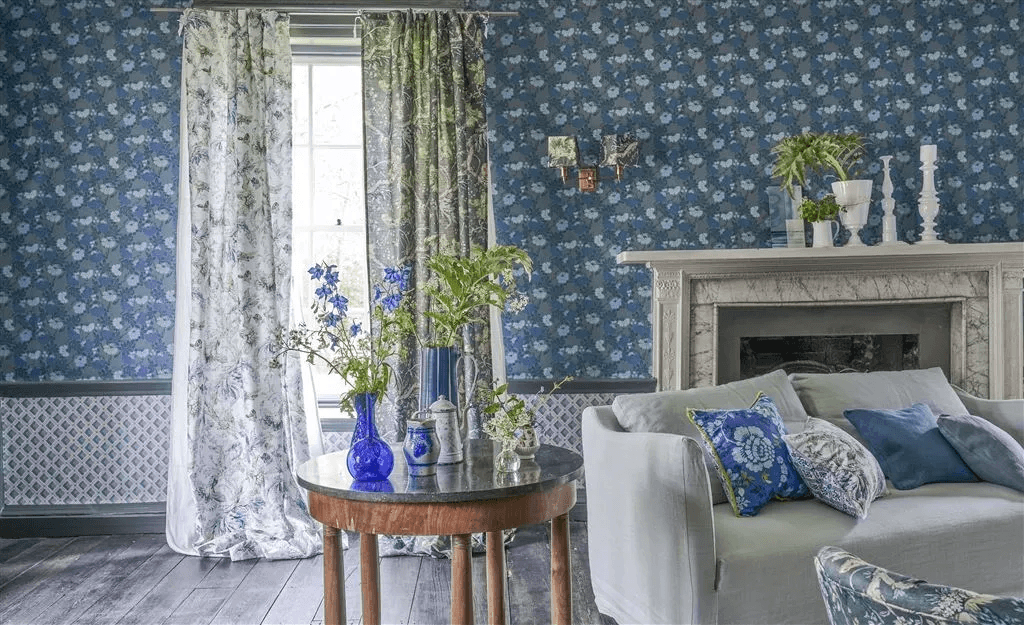
London Wallpaper: English Heritage × Designers Guild
Key Takeaway
The English Heritage by Designers Guild collection began in an archive at Wrest Park, Bedfordshire, where over 1,500 fragile wallpaper fragments — some dating to c.1690 — have been conserved for decades. Designers Guild curated, re-drew, and faithfully reproduced six designs across 22 colourways using traditional printing methods. The collection is now available at John Lewis for £58 per roll. It is a masterclass in what institutional heritage IP can become when the right creative partner is given meaningful access.
Insight
ARTiSTORY Staff
• 3 minute read
Three Centuries of London Wallpaper, Re-drawn by Hand
The Archive That Started Everything
Wrest Park, Bedfordshire, is one of the grandest landscape garden estates in England. English Heritage cares for it today — its baroque water parterre, its woodland walks, its neoclassical orangery. But beneath the grandeur, Wrest Park also serves a quieter function: it is the home of the Architectural Study Collection (ASC), one of the most significant repositories of historic architectural and decorative objects in the UK.
English Heritage × Designers Guild partnership — wallpaper archive to living room.
Credit: © English Heritage. Source: english-heritage.org.uk
The ASC is not a museum in the conventional sense. It is a working archive — a place where fragments of demolished and restored buildings come to rest, conserved and catalogued for research and reference. Its wallpaper holdings alone number over 1,500 fragments, drawn largely from houses in and around London. The dates range from the 18th century through to the 19th, though the earliest fragment pushes further back still.
That fragment — c.1690–1700 — was salvaged in the 1960s from a terraced house during demolition work in Paradise Row, Lambeth, south London. It is believed to have been manufactured near St. Paul's Churchyard, the hub of the 18th-century wallpaper manufacturing trade in the city. Nobody knows who chose it, who hung it, or who lived beneath it. What survives is the paper itself: a thin, fragile record of taste and trade from the final decade of the 17th century.
For decades, it sat alongside more than a thousand companions. Then English Heritage opened the archive to Designers Guild.
A Study Collection Meets a Design Studio
Designers Guild — the British premium fabric and wallpaper house founded by Tricia Guild in 1970 — was granted access to over 1,500 fragments from the ASC. The brief, in essence, was this: look at what is here, find what is worth bringing back, and do it faithfully.
The design team moved carefully. Not every fragment translates into a contemporary product — some are too damaged, some too niche, some too dependent on technologies that no longer exist. But across the collection, six designs emerged with genuine creative potential: patterns rich enough in detail and story to bear re-interpretation, and broad enough in character to speak to a contemporary interior.
Each design was then re-drawn — a painstaking process of tracing, refining, and restoring patterns that had faded, torn, or been altered over centuries. The guiding principle throughout was fidelity: to remain as close as possible to the original, not to modernise it. Colour palettes were updated, yes — chosen to be harmonious for contemporary use — but the patterns themselves were treated with the kind of reverence usually reserved for museum objects.
For printing, the studio chose traditional surface and gravure rotary printing methods. This decision was deliberate and specific: these techniques capture surface texture and fine line detail that digital printing methods smooth away. The resulting wallpapers have a physical quality — a depth and irregularity — that reflects their archival origin.
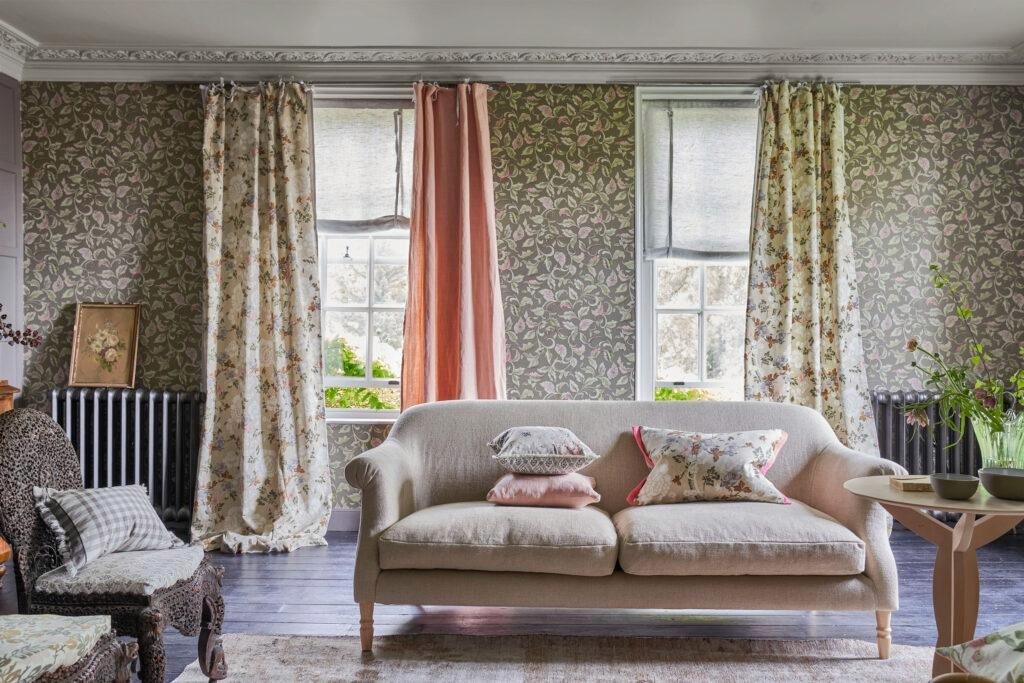
Archival Influences: English Heritage × Designers Guild wallpaper in contemporary setting.
Credit: © The English Home / Designers Guild. Source: theenglishhome.co.uk
The Six Designs: Stories in Pattern
Amsee Geometric is the most architecturally resolved of the six — a structured geometric pattern available in six colourways (Castle Wall, Lichen, Moss, Portcullis, Sandstone, Slate Blue) that speak directly to English Heritage's castle and manor contexts. It is versatile in the way that only a genuinely good pattern can be.
Carlisle Fauna (Forest, Woad, Woodland) draws on the English tradition of illustrated natural history — fauna rendered with the precision of a botanical study. English Garden Floral (Birch, Delft, Willow) and Piccadilly Park (Delft, Lichen, Parchment, Woodland) continue this pastoral tradition, their colour names evoking the specific English landscape palette that gives them their context.
St John Street Trellis (Delft, Duck Egg, Ink, Slate, Vintage Rose) is named for its archival provenance — a trellis pattern of structural elegance that works across five very different colourways. Its geometry reads as modern; its origin is anything but.
And then there is Craven Street Flower — the most singular design in the collection. It derives from a fragment found at No.37 Craven Street, a house in central London built around 1731. The date of the wallpaper itself is less certain. What is certain is that when the Designers Guild team examined it, they found something that resisted simple re-drawing. The pattern's delicate, vintage romance — its sense of something at once intimate and unknowable — could not be captured by tracing alone. So they did something unusual: they created entirely new original artwork, hand-painted from scratch, to retain the spirit of the original rather than its letter. Craven Street Flower is available in a single colourway, Delft — and it may be the most quietly remarkable design in the range.
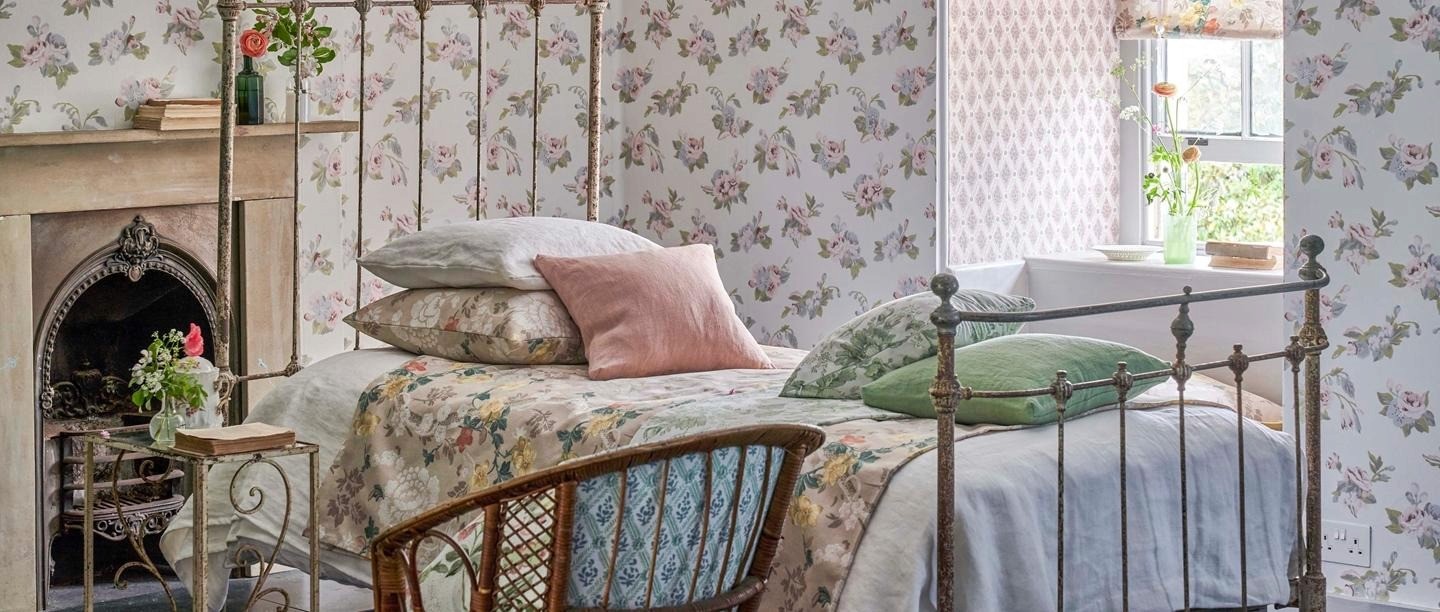
English Heritage × Designers Guild — Heritage Wallpaper collection in a period interior.
Credit: © English Heritage / Designers Guild. Source: english-heritage.org.uk
Eagle House: The Deepest Provenance
Among the six designs, one story goes deeper than the rest — not into the collection but out of it, into history.
Eagle House is a Jacobean manor house in Wimbledon, south-west London. It was built between 1613 and 1617 for Robert Bell — a merchant of considerable means and ambition, who was among the co-founders of the East India Company, the trading corporation that would go on to shape the history of three continents. Eagle House was built at the height of Bell's success. It was a statement, as grand houses always are.
In 1700, the property was acquired by Sir Richard Ivatt, a City of London Alderman. It was Ivatt who installed the wallpaper that would eventually find its way into the English Heritage archive. The design is a block-printed damask — rich, formal, precisely what one would expect in a property of this standing. But what made the Eagle House fragments extraordinary was not the pattern itself. It was what someone — Ivatt, a member of his household, an unknown hand — had done to them. Applied directly to the surface of the printed damask were decoupage paper flowers: delicate cut-paper blooms, overlaid on the pattern, creating something between wallpaper and artwork.
English Heritage removed the fragments from Eagle House in the late 1980s. They are now in archival storage at Wrest Park. The decoupage flowers survived.
When Designers Guild re-worked the Eagle House Damask for the collection, the question of those flowers was central. They could have been edited out — treated as damage, or as an eccentric intervention too specific to reproduce. Instead, Designers Guild kept them. The decoupage flowers appear in the contemporary re-working, not as a historical curiosity but as a design feature — so that an anonymous act of domestic creativity from 1700 becomes part of a wallpaper available in 2024.
That decision captures something essential about what this collection does at its best: it does not simply mine the archive. It respects it.
From Wrest Park to John Lewis
The English Heritage by Designers Guild collection is available at John Lewis for £58 per roll. That price point and that retail context are both significant.
John Lewis is not a museum shop. It is one of the most trusted retailers in the UK — a mainstream home environment where quality, value, and story are expected to coexist. The English Heritage range does not sit behind a glass case; it sits on a shelf, alongside other considered homeware, available to anyone with a wall to cover and a story they want to bring into their home.
This is institutional heritage IP doing what it should: moving from archive to living room, accessible without being cheapened, faithful without being merely academic. English Heritage provides the depth of provenance. Designers Guild provides the interpretive skill. John Lewis provides the reach.
The wallpaper from Paradise Row, Lambeth — c.1690, unknown origin, salvaged from a demolition site sixty years ago — helped inspire a collection that thousands of people will hang in their homes this year. The archive was always there. It just needed the right bridge.
Frequently Asked Questions
Q1: What is the English Heritage Architectural Study Collection, and where is it held?
The Architectural Study Collection (ASC) is an archive maintained by English Heritage at Wrest Park, Bedfordshire. It contains over 1,500 fragments of architectural and decorative objects — predominantly 18th and 19th century — including a significant holding of wallpapers from demolished or restored London houses. The earliest wallpaper fragment in the collection dates to approximately 1690–1700.
Q2: How many designs does the English Heritage by Designers Guild collection include, and where can I buy them?
The collection comprises six designs across 22 colourways: Amsee Geometric (6 colourways), Carlisle Fauna (3), Craven Street Flower (1), English Garden Floral (3), Piccadilly Park (4), and St John Street Trellis (5). The collection is available at John Lewis for £58 per roll, and can be explored at designersguild.com.
Q3: What is the story behind the Eagle House Damask?
Eagle House is a Jacobean manor in Wimbledon built 1613–1617 for Robert Bell, co-founder of the East India Company. The wallpaper was installed by City Alderman Sir Richard Ivatt in 1700. The original fragments bore hand-applied decoupage flowers laid over the printed damask. Designers Guild retained those flowers in the contemporary re-working — so a 300-year-old act of domestic creativity became a deliberate design feature.
Q4: Why is the Craven Street Flower only available in one colourway?
Craven Street Flower is adapted from a fragment found at No.37 Craven Street, London (built c.1731). Because the delicate, romantic quality of the original could not be faithfully captured through re-drawing alone, Designers Guild created entirely new hand-painted artwork. The resulting design is available only in Delft — a considered editorial choice that honours both the rarity of the original and the integrity of the creative process.
Q5: What printing methods were used, and why?
Traditional surface and gravure rotary printing methods were used. These were chosen specifically because they preserve fine surface detail and textural depth that modern digital printing methods tend to flatten — important when the source material is a fragile, centuries-old fragment whose material qualities are part of its historical value.
Q6: Where does the earliest wallpaper fragment in the collection come from?
The earliest fragment (c.1690–1700) was salvaged in the 1960s from a terraced house in Paradise Row, Lambeth, south London. It is believed to have been manufactured near St. Paul's Churchyard — the centre of London's 18th-century wallpaper trade. It now rests in the Architectural Study Collection at Wrest Park, Bedfordshire.

Connecting cultures through meaningful brand collaborations and authentic storytelling that drives both impact and revenue.
" height="15.00095079498291px" id="KzAesqen_" width="15.887237074279785px"/></svg>)
" height="40px" id="PdXwlesgs" width="40px"/></svg>)
" height="16.6667px" id="bN179avM0" width="16.66250000000001px"/></svg>)
" height="40px" id="sK1n39Y12" width="40px"/></svg>)
" height="13.333300000000001px" id="e3sm3FX65" width="16.662000000000006px"/></svg>)
" height="40px" id="BlhXMiVl0" width="40px"/></svg>)
" height="16.666358956956856px" id="WrXlTUAw7" width="16.668330260537772px"/></svg>)
" height="40px" id="nKu2x0iOq" width="40px"/></svg>)
© 2026 ARTiSTORY. All rights reserved.
Privacy Policy
Terms of Service
Cookie Policy