
Hermès: From Tang Dynasty Craft to Collection Piece
Key Takeaway
For Autumn 2016, Hermès Shanghai Maison invited Zhao Shuxian — 50-year master and Representative Inheritor of Jiangsu Provincial ICH "Velvet Flower Making Techniques" — to create a window display installation with designer Zhang Lei. The result was a 1.6-metre feather sculpture and a 60-centimetre chrysanthemum stand, both crafted in traditional velvet flower technique, both permanently collected by Hermès. It remains one of the most significant examples of luxury and intangible cultural heritage in genuine dialogue.
Insight
ARTiSTORY Staff
• 3 minute read
How Hermès Turned a Tang Dynasty Craft into a Permanent Collection Piece
A thousand-year craft, a single window, and two objects that never left
In Autumn 2016, a window at Hermès Shanghai Maison held something that had never existed before: a feather, 1.6 metres tall, crafted entirely from natural silk threads and copper wire using a technique over a thousand years old.
The feather did not represent Hermès's autumn season. It was the autumn season — autumn's falling, floating, weightless nature expressed through one of China's most delicate living crafts.
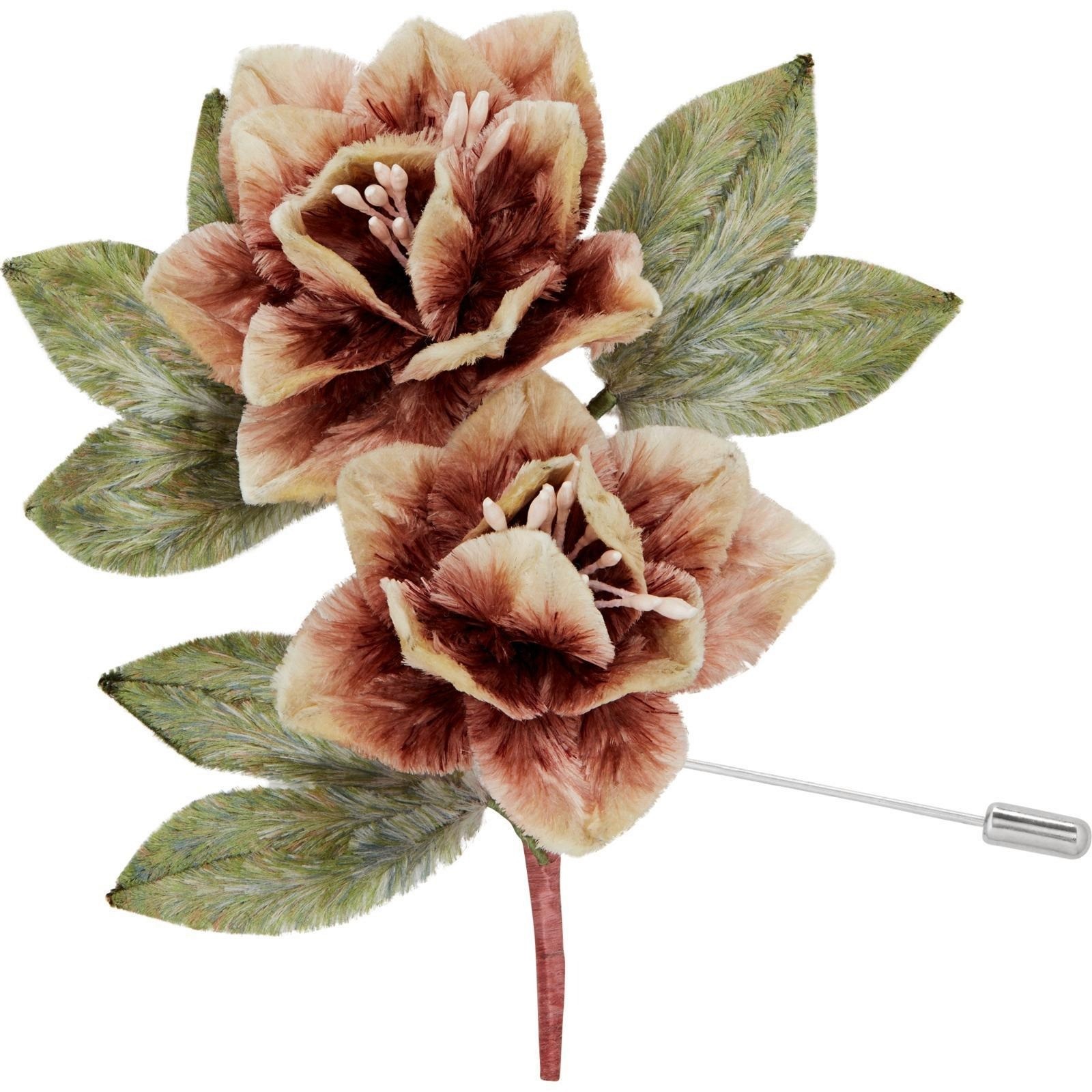
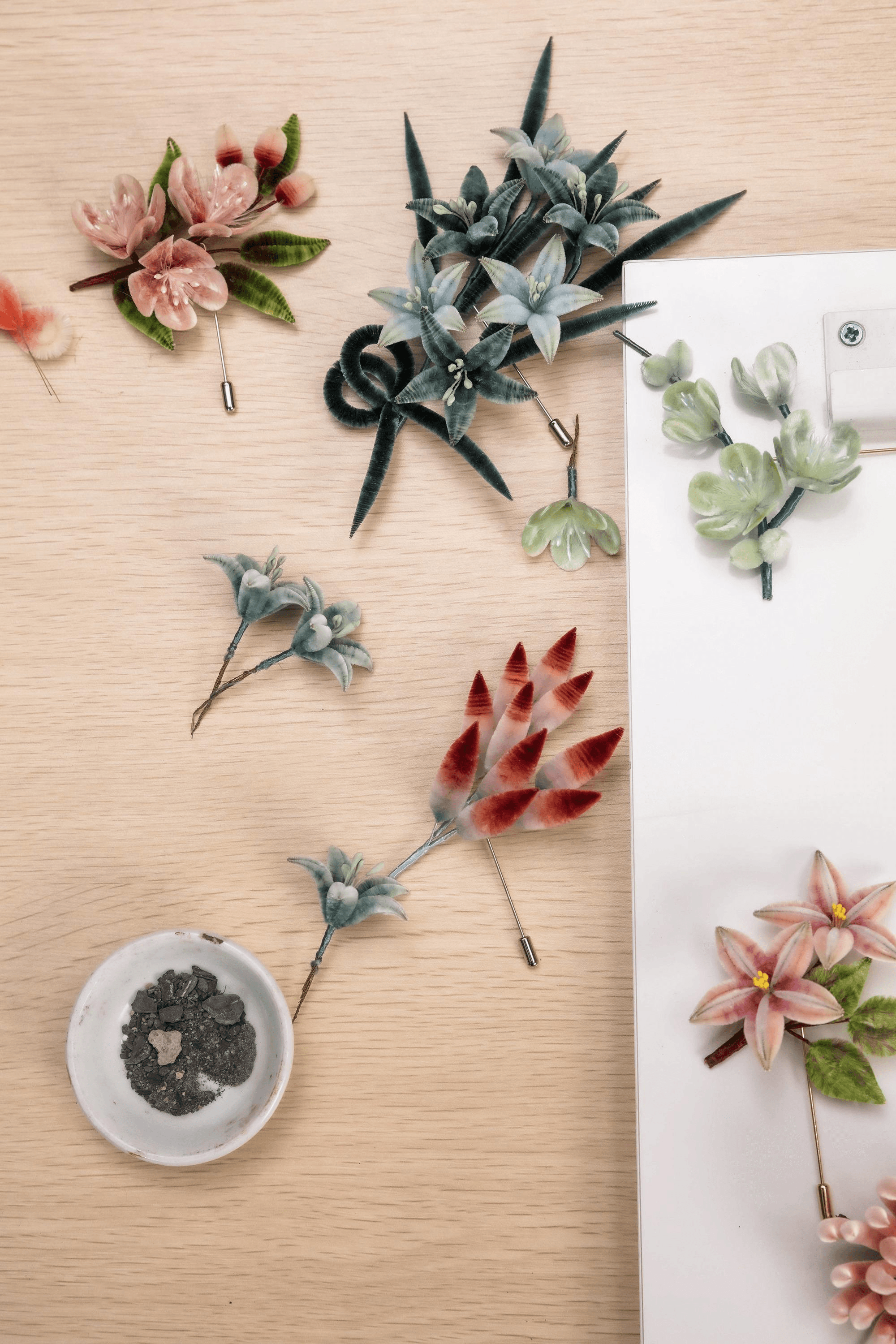
Nanjing velvet flower (绒花) — silk and copper wire craft, ICH tradition.
Credit: © China Daily HK. Source: chinadailyhk.com
Nanjing Velvet Flowers: A Craft That Began at Court
Velvet flower making (绒花, rónɡhuā) is a Nanjing craft with its roots in the Tang Dynasty, when these intricately formed silk flowers were sent as royal tribute to the imperial court. Over centuries, the craft moved from palace to street, becoming part of Nanjing's folk culture — worn at festivals, displayed in homes, gifted between families.
The technique is entirely handmade. Natural silk threads are wound around fine copper wire and hooked into velvet strips (a process called hooking). A craftsperson then uses scissors to cut and shape these strips into precise forms (trimming), before assembling the elements into the final flower or object (combining). The result has a texture and colour depth that no machine process has ever replicated — the silk's natural lustre, the dimensional softness of each petal.
Today, velvet flower making is recognised as a Jiangsu Provincial Intangible Cultural Heritage under the designation "Velvet Flower Making Techniques."
The Master: Zhao Shuxian
Zhao Shuxian entered the Nanjing velvet flower museum at age 19. He has practised the craft for fifty years and holds the title of Representative Inheritor of the Jiangsu Provincial ICH.
His philosophy is not nostalgic — it is expansive. "Integrate it into daily life," he has said. "Reflect fashion in everyday life. It is essential to involve young people and designers, bringing fresh perspectives."
That philosophy made him the right person when Hermès came calling.
The Collaboration: "Using Feathers to Hold Up a Silk Scarf"
Working with designer Zhang Lei, Zhao Shuxian approached the Hermès Autumn 2016 brief through the lens of nature — the seasonal palette of animals, insects, stones, flowers, and trees. The conceptual anchor became the feather: light, structural, airy — and the perfect metaphor for the Hermès silk scarf itself. The concept was articulated simply: "using feathers to hold up a silk scarf."
What Zhao created pushed velvet flower craft beyond its traditional scale entirely.
The centrepiece was a 1.6-metre feather sculpture, built using velvet flower technique at a size the craft had never attempted. Accompanying it: a 60-centimetre chrysanthemum display stand, each petal shaped and assembled by hand. Together, they formed the heart of the Hermès Shanghai Maison Autumn window — butterflies, fallen leaves, and feathers rendered in silk, copper wire, and fifty years of accumulated skill.
Permanent Collection
At the close of the display season, Hermès did not return the pieces. Both the feather sculpture and the chrysanthemum stand entered the brand's permanent collection.
That decision is meaningful. It positions the work not as seasonal display or commissioned prop, but as a luxury art object — validated by one of the world's most rigorous arbiters of craft quality. For Nanjing velvet flower technique, it is an act of institutional recognition that carries weight far beyond any award.
What This Means for Cultural Heritage
The Hermès × Zhao Shuxian collaboration is, a decade on, still the most-cited example of luxury and Chinese intangible cultural heritage in genuine creative partnership. It demonstrates three things clearly:
ICH craft can operate at any scale, given the right collaborator and the right brief.
The aesthetic language of living heritage traditions is fully fluent in contemporary luxury contexts.
When approached with depth and care, ICH collaborations produce objects that last — and that brands want to keep.
At ARTiSTORY, these three principles form the foundation of every cultural IP partnership we build.
FAQ
Q1: What is Nanjing velvet flower craft (绒花)?
Nanjing velvet flower craft (绒花, rónɡhuā) is a traditional Chinese handcraft using natural silk threads wound around copper wire. Artisans hook the silk into velvet strips, trim them into shapes, and assemble them into three-dimensional flowers and objects. It is recognised as a Jiangsu Provincial Intangible Cultural Heritage.
Q2: When did Hermès collaborate with a velvet flower master?
For its Autumn 2016 window display at Shanghai Maison, Hermès collaborated with designer Zhang Lei and Zhao Shuxian, Representative Inheritor of the Jiangsu Provincial ICH "Velvet Flower Making Techniques," to create two installations using traditional velvet flower craft.
Q3: What did Zhao Shuxian create for Hermès?
Zhao Shuxian crafted a 1.6-metre feather sculpture and a 60-centimetre chrysanthemum display stand, both using traditional velvet flower technique. These broke the traditional scale limits of the craft and were both permanently collected by Hermès.
Q4: What is the history of velvet flower making in China?
Velvet flower making dates to the Tang Dynasty, when the flowers were sent as royal tribute. Over centuries the craft spread to common people and became part of Nanjing's folk culture. Today it holds Jiangsu Provincial ICH status.
Q5: Why was the Hermès velvet flower installation permanently collected?
Both the feather sculpture and chrysanthemum stand were permanently collected by Hermès — a recognition that the ICH craft output, when pushed beyond its traditional limits in collaboration with a contemporary designer, constitutes a luxury art object. It remains one of the most significant institutional validations of Chinese intangible cultural heritage by a global luxury brand.
Q6: What does ARTiSTORY do with intangible cultural heritage?
ARTiSTORY builds the curatorial, ethical, and storytelling infrastructure for brands and retailers to engage with ICH masters and their traditions at scale — enabling collaborations that are culturally authentic, creatively ambitious, and lasting.

Connecting cultures through meaningful brand collaborations and authentic storytelling that drives both impact and revenue.
" height="15.00095079498291px" id="KzAesqen_" width="15.887237074279785px"/></svg>)
" height="40px" id="PdXwlesgs" width="40px"/></svg>)
" height="16.6667px" id="bN179avM0" width="16.66250000000001px"/></svg>)
" height="40px" id="sK1n39Y12" width="40px"/></svg>)
" height="13.333300000000001px" id="e3sm3FX65" width="16.662000000000006px"/></svg>)
" height="40px" id="BlhXMiVl0" width="40px"/></svg>)
" height="16.666358956956856px" id="WrXlTUAw7" width="16.668330260537772px"/></svg>)
" height="40px" id="nKu2x0iOq" width="40px"/></svg>)
© 2026 ARTiSTORY. All rights reserved.
Privacy Policy
Terms of Service
Cookie Policy